ASIA

DRM holds first in-person General Assembly post-Covid

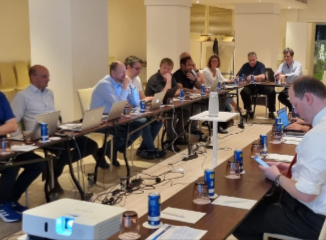
The Digital Radio Mondiale™ (DRM) Consortium held its first in-person General Assembly in Palma de Mallorca, Spain, post-Covid, between April 27-28, under the banner “Smart, Local and Efficient”.The open session on April 27 brought exciting updates from all the continents, with new information from India, South Africa, Pakistan, Brazil and Germany.It received fresh information directly from the top representatives of the Indonesian Communication Ministry – Kominfo – present in Palma and from the highest echelons of the Indonesian public broadcaster.A surprise announcement was made during the GA about the start of DRM tests in Nepal, as well and welcomed the news from Pakistan and its full plans, commitment to receivers and asking for DRM mandate in cars.Some of the key members brought their own excellent news about DRM developments (like a recent monitoring test of low-cost DRM receiver in Europe -BBC, the multi-channel capabilities of DRM in the FM band- RFmondial and the exciting link established between the ATSC 3.0 standard and DRM- Fraunhofer IIS).The receiver session, with participation from CML Microcircuits/Cambridge Consultants, Gospell, Inntot, Fraunhofer IIS, Starwaves, NXP and others confirmed the great and innovative progress made in creating receivers for the automotive industry, recent mobile solutions and standalone receivers. The existing and new receiver solutions are already supporting the full DRM standard (AM and FM bands) and all the DRM features set giving extra benefits like EWF (Emergency Warning Functionality), distance learning, extra content in various languages.The “DRM open day” was a global and interactive event with participants from countries as far apart as Malaysia, Nepal, Singapore, several African countries, Colombia, US, UK, Egypt, Hungary, Denmark, Thailand and so many more.On April 28th the DRM Consortium members debated and finalised the strategic directions for the coming year, with its emphasis on receivers, key areas of the world, like Asia and Africa, and general communication.“The DRM General Assembly 2023 was an up-to the-minute showcase of our recent successes and future activities in this ever-evolving digital world”, says Ruxandra Obreja, DRM Chairman. “Digital Radio DRM has proven with clear facts and figures that it is global, flexible and in tune with local needs; its energy and spectrum efficiency are also noteworthy and should be really promoted. The receiver progress has been remarkable. The General Assembly participants all agreed that it now needs to translate in mass production and take up of car and other receiver solutions. The DRM Consortium is in rude health. Its greatest asset is its members whose valuable expertise and activity prove that DRM is a current, perfect solution for all needs and territories, allowing everyone to stay informed, educated and safe, wherever they are.” […]

ASIA

TRAI seeks views on low power small range FM radio broadcasting

The Telecom Regulatory Authority of India (TRAI) has released a Consultation Paper (CP) on “Issues Related to Low Power Small Range FM Radio Broadcasting”.Ministry of Information and Broadcasting (MIB) had sought recommendations of the Authority on the need and timing for introduction of new service provider for drive-in theatres application.The Authority said that low-power short-range FM Radio broadcasting is an effective method of sound broadcasting for services that are intended for limited locations and reception areas like drive-in theatres, hospital radio services, amusement parks, business premises, closed communities such as residential complexes, small habitations, local events such as air shows and sports events.Written comments on the consultation paper are invited from the stakeholders by May 15, 2023.Counter comments, if any, can be submitted by May 29, 2023The issues for consultation include:1) Should the use of low power small range FM Radio broadcasting by various entities be licensed or unlicensed?2) In case the use of low-power small-range FM Radio is licensed, whether there is a need for the introduction of a new category of service provider for using low-power small-range FM Radio broadcasting?3) Should the low-power Radio equipment continue to be subjected to type approval by WPC?
If yes, do the current technical specifications/approval process require any amendment/ modification/ simplification?
If not, please suggest how to ensure quality standards for the equipment and users of low-power FM services.
4) In case, stakeholders consider that a license is necessary for low power small range FM broadcasting, what should be the:
Eligibility criteria
Period of License
Entry Fee
License Fee
Area of operation
Policy/ Methodology for allocation of Spectrum
Prescribed Technical parameters, if any
Any additional terms and conditions governing such license.
5) Whether particular frequencies in the existing FM band can be dedicated to low-power FM Radio broadcasting?6) What should be the licensed area of frequency assignment- location-wise (Stadium, Auditorium, Malls, Residential complex etc.) or citywise?7) What should be the maximum power of a low-power small-range FM transmitter?8) Stakeholders may also provide their comments on any other issue relevant to the present consultation. […]

ASIA

Coaching Talent – Part 2

Content from BPRThere are many ways to coach & direct talent.Each programmer has his/her own style. Each individual talent will often require different ways to coach them depending on their personalities & experience.Here are a few strategies & suggestions to coach talent effectively:
Set clear goals and expectations: Clearly communicate what is expected of the talent and provide clear and measurable goals to help them stay focused and motivated.

Provide regular feedback: Regularly provide feedback on their performance, both positive and constructive, to help them understand what they are doing well and where they need to improve.

Encourage self-reflection: Encourage the talent to take responsibility for their own development by encouraging self-reflection and self-evaluation. Ask them what they thought of their show that day…. how do they think it could have been better?

Create a supportive environment: Cultivate a culture of growth by creating a supportive environment that encourages the talent to take risks, experiment and make mistakes without fear of failure. Of course, the caveat is that they do all this within the bounds of responsible broadcasting and their actions won’t put their career or the station’s reputation in jeopardy.

Recognise and reward success: Show appreciation and recognition for the talent’s achievements and hard work, it can be a strong motivator.

Ensure the transfer of knowledge: Talent must understand the essence of the station’s format, the audience it is trying to target and the overarching strategy designed to achieve success. This way, the talent knows what must be done on air to reach the desired goals for the station.
By David Kidd, BPR […]

ASIA

What Results Do Your Clients Expect From Their Advertising?

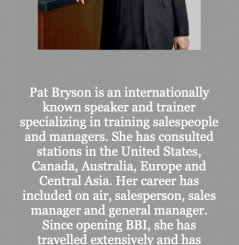
Selling Radio Direct with Pat BrysonI was on a zoom call a couple of weeks ago with a very good salesperson. She had emailed me to say that she had been experiencing a rash of cancellations in the past few weeks. After a strong 2022, a “rash” of cancellations seemed out of place. What was going wrong? This was the topic of our zoom call.I asked her to give me one example so that we could do a forensic analysis of the process. This particular business was a garage door company. Although they had agreed to a long-term schedule, they wanted to cancel after 3 weeks. My first question was, “How long do people think about buying a garage door before they do?” (Unless their current door malfunctions and their car is stuck in the garage.) The answer is several months. Why, then, would it make sense to expect phone lines to light up in three weeks? It doesn’t but our clients don’t understand that. In their heart of hearts, they expect to air a commercial today and have the teeming masses show up tomorrow shouting our call letters.Which brings me to the point of this newsletter. How well do we manage expectations UP FRONT with our clients? Do we quantify what they should expect? Example: “I want more traffic in my store.” “Ok, how much more? How much traffic do you have now? How long did it take you to achieve your current level of traffic? How quickly do you expect the additional traffic to happen?”We need to quantify their expectations. And, if those expectations are entirely out of whack (that’s an Oklahoma term for “ridiculous”) we need to tell them. We know how advertising works. We know the process to educate potential customers. And, we know how long it takes. We need to explain the recipe for effective advertising:
Enough repetition per week to reach a 3 frequency.
Consistent enough (at least 52 weeks).
A relevant message.
Results will build over time. Depending on the product and the product’s gestation period, results will come sooner or later. Usually, advertising has ramped up to generating great results between 6 and 9 months into the campaign. This doesn’t mean your clients won’t see results before that, it simply means that peak momentum will not have been reached yet. Think “train” starting down the tracks and gathering speed till it is running at full capacity.The key to happy clients is to educate them on what their advertising can and will do if done properly. This education must be done at the time you are selling them, not later when they want to cancel. At that point, it sounds like an excuse. If done up front, you sound like a marketing genius as you accurately predict the trajectory of their campaign. And, if after preparing them for delayed gratification, their ad happens to hit a 2%’er who is buying today and comes in immediately, you look like a hero.I’m always happy to work through a forensic analysis with you to determine a strategy to save business and hopefully to resell these clients. My thanks to the salesperson who reached out to me and provided the inspiration for this newsletter. I hope other readers will benefit from her experience. We get better by analyzing our wins and our losses. That’s how we improve!Happy Selling! […]

ASIA

First speakers announced for Radiodays Asia 2023

Radiodays Asia, the leading radio and podcasting conference in the Asia-Pacific, has announced its first set of speakers for this year’s event which will be held 5-6 September in Kuala Lumpur, Malaysia.Nazri Noran, CEO, Media Prima, MYNazri has over 20 years of experience in the entertainment industry. From his broad and extensive experience in the radio broadcast industry, he is known for specialising in creating content that resonates with the local audience.As Chief Executive Officer of Media Prima Audio, Nazri is in charge of its overall strategy and operations to further strengthen its position as a leading radio network.Nazri most recently served as Senior Assistant Vice President of Astro Radio Malay and Tamil where he headed its radio brands ERA, Sinar, Gegar, ZAYAN and Raaga. He began his career with Astro Radio in 2001 where he served various roles with hitz FM, xfresh FM and Sinar FM.Paul Kaye, VP, Music Brands & In House Productions, Rogers, CANPaul has over 10 years of senior/executive leadership experience & 20+ years in media & entertainment. Considerable background in performance coaching, team development, strategic planning, brand building & content creation.In 2016, Paul joined Rogers as Vice President, Product & Talent Development in 2020 his role expanded as he became Vice President, Music Brands & In House Productions. Paul is now responsible for the strategy and brand development of the company’s music-based audio brands and in house TV productions.Kim Blair, Content Director, Magic Talk Network, NZKim has been in the radio industry for 26 years. Starting in a small country town in rural Western Australia to Sydney and now Auckland, New Zealand. Starting as an on air announcer, Kim is also an award winning radio programmer. He is currently the Content Director for the Magic Talk Network, one of New Zealand’s newest news/talk radio stations.Radiodays Asia is a collaboration between Radiodays Europe, the world´s largest and leading conference for radio, audio and podcast, and broadcasting and podcast partners in Asia and Australia. The 2023 edition will run over 2 days in 2 tracks with 50 sessions. Top international speakers and industry leaders as well as successful producers and market experts will share their insights.Register for Radiodays Asia at Super Early Bird prices before June 1. […]

ASIA

Coaching Talent – Part 1

Content from BPRAs a programmer coaching talent can be difficult for a number of reasons.It requires a deep understanding of the talent’s strengths and weaknesses as well as the ability to effectively communicate and motivate them to improve. Additionally, as a coach you have to be able to adapt to the unique needs and goals of each individual, as well as being able to provide constructive feedback and guidance. You will need to create a positive and supportive learning environment and to build trust and rapport with the individuals being coached. All these skills are not common in any given individual and require a lot of time and experience to master.Here are some bullet points on why coaching talent can be a difficult task:
Resistance to change: Talent may be resistant to feedback or suggestions for improvement, which can make it difficult to effectively coach them. They may think “sure you are the PD but where’s your on air experience?” This is of course is a naïve approach…some of the greatest film directors have never been actors. Some of the greatest football coaches have never been star players.

Lack of self-awareness: Often talent may not be aware of their own strengths and weaknesses, which can make it difficult for a PD to identify areas for improvement.

Communication: Effective communication is key to successful coaching, but some talent may have difficulty understanding or accepting feedback. They immediately get defensive. Conversely, the PD may need to polish up their communication skills to deal with talent on an individual basis and not just a “one size fits all” approach.

Lack of trust: If a PD is not able to build trust and rapport with the individual/show being coached, it makes it very difficult to effectively guide and motivate them.

Limited time: Coaching talent can be time-consuming, and some PD’s may not have enough time to devote to each individual. Let’s face it most PD’s in 2023 are under a lot of time pressure.

Lack of experience: Coaching talent requires experience and knowledge; some PD’s may not have the necessary skills and knowledge to effectively coach the individual. This will of course result in push back from the talent.

Finally……the talent just hasn’t got “it” to make to the next level. They’re good but not great….no matter how many hours you put in….and you need great.
By David Kidd, BPR […]