
ASIA

The lost art of selling spots and dots: Jamie Wood

BRISBANE, Australia – I have a confession to make: I had severe writer’s block before finally coming up with the topic for this article. You see, throughout the duration of my career, the industry has been primarily focused on deeper content integration, new emerging platforms, monetizing digital, and future-proofing revenues. Because of this, many of us are guilty of neglecting perhaps the most important aspect of radio sales: selling commercials.Don’t get me wrong. While we absolutely need to focus on diversifying our product mix, maximizing non-spot revenue, and commercializing our sponsorships and talent reads, the fact remains that pre-recorded commercials still represent the overwhelming majority of inventory sold on a radio station. Taking time to consider how you craft, sell, and deploy these commercials will not only give you a sales edge and make the campaign work harder, they may just gain the approval of a highly discerning Program Director!Here are four things to consider when looking to optimize your clients’ pre-recorded commercials:

Respect the format of the radio station.This one cannot be understated. Although a loud and obnoxious commercial laden with “earwigs” might help the brand cut through the clutter, it’s been my experience that commercials work a lot harder when they fit naturally into the format of the station. Is the station rock or adult contemporary? Are the announcers outgoing and bombastic, or do they have a more understated delivery style? What is the personality of the radio station and brand? The more you can replicate this style and feel, the more likely it will be invited in by the listener. This type of thinking can also help you gain a sales edge. I remember winning a large national contract with a fast-food brand due to our approach to their pre-recorded commercials. Naturally, all the networks were vying for this revenue and throwing all kinds of entitlements and value into their proposals. Debriefing with the client as to why we were successful, they told us we did one thing differently (which essentially decided it for them): we took the same piece of creative and tweaked the music bed to fit in with the format of each station (rock, ’80s, soft rock, pop, and R&B). This simple tweak added an entirely new dimension to the value proposition we were putting forward.Treat commercial airtime like content airtime.I’ll let you in on a little secret: the audience doesn’t consume radio the way we sell it. Everything that comes out of the speakers, be it content or commercial airtime, is a representation of the entire radio station to the listener. When formulating your commercials, you need to really think about this dynamic with the audience. How do you give the audience entertainment? How do you hook them at the top and keep them listening? How do you make sure there is a value exchange there for giving their attention? So much of great radio programming is about hooking, teasing, and then delivering the payoff; our approach to commercials should be the same.Leverage contextOne of the easiest wins that you can have is creating and instructing different creative executions to run during different days and dayparts. Resist the tropes and traps of overtly stating the context, such as “Monday-itis anyone?” Instead, really try to speak to the audience in a way that’s appropriate for the time they are listening. A Monday morning and a Friday afternoon are two very different mood states and mindsets for the audience. A Monday morning might be key for “information gathering” and setting the agenda for the week, whereas a Friday afternoon is about winding down and transitioning from work to family life. Think about how these two different need states might influence the copy, read, and music bed of the commercial. One of my favourite examples of this was a coffee brand that would advertise their drive-through options in the AM, promote the instant coffee options at 2 pm – 3 pm to fend off those afternoon energy slumps and then push their hot-chocolate ahead of the evening wind down.Mess with the clocks!30 seconds is a unit of time, that’s it. Don’t miss the opportunity to take that 30 seconds and re-divide it to make your clients’ commercial execution more impactful. Does a 15-second top and tail drive more engagement? Could you do a 15-second commercial and then splice 3 x 5-second “sonic triggers” throughout the break? What about a 15-second at the top teasing a 45-second “feature” at the end of the break? Don’t think about these executions as a clever tactic to sell but rather as a mechanism to tell the client’s story in a unique way.The Lesson: In a world of content integration, multi-platform executions, audio ecosystems, and digital amplification, there is still no better vehicle to connect a radio audience with a client’s brand than a pre-recorded commercial. Sometimes you simply can’t beat a classic!Jamie Wood is the Global Sales Director of Boost Media International, Boost provides revenue solutions and advisory services to media companies globally.  Jamie also hosts Media Sales Mastery a top rated podcast showcasing best practice from some of the industry’s top thought-leaders.   […]

ASIA

Let’s Put Radio Advertising in Perspective

Selling Radio Direct with Pat BrysonWhat CAN advertising do for businesses?In their heart of hearts, businesspeople want to run an ad today and have teeming multitudes run into their store tomorrow screaming out our call letters.

Since they all start with “K” or “W” in the US at least, customers will find it confusing at best to attribute their arrival to ads heard on our stations. Also, it’s not their job to help businesses know how their advertising is working. Customers want to get their needs met in the most expeditious way and go on with their lives.Measuring traffic flow is the best way to know if advertising is working. Over time, traffic should increase if advertising is effective. Note, I didn’t say “sales”. Once a potential customer crosses the threshold, it’s up to the business to sell them. Often, we get an interested potential customer into the store, but the “friendly, knowledgeable personnel” fail to sell them.Most advertising is designed to work over time. Why? Because on any given day, the national average for people who are “hot” consumers (those who are planning on buying TODAY) is only 2%. “Warm” consumers (those who are thinking about buying and developing their criteria for a purchase) make up only 8%. That means that statistically, 90% of the population is “cold”. They are NOT planning on buying today and aren’t even thinking about it.Our clients seem to think that every time one of their ads airs, everyone within their trade area is wanting to buy what they are selling. Not so.The main objective of advertising should be to predispose the 90% and the 8% to buying from our clients when they have the need. And no one, not us nor our clients can determine exactly when that need will arise. Advertising’s job is to make sure that customers will at least go into our clients’ stores or call them, or go online to their websites and give them a chance to serve them. Otherwise, if our clients’ names are not in the customer’s mental file drawer, they will never see that person. The customer will end up in one of the national chains that does have space in their file drawer.As we are in the sales process, we need to explain to our prospects how advertising works. The 2%, 8% and 90% also explain why advertising should be consistent and long-term. As advertising professionals, it’s up to us to craft campaigns that will work. Higher revenue awaits for our clients and for us.Main Photo: ShutterstockPat has a New Book […]

ASIA

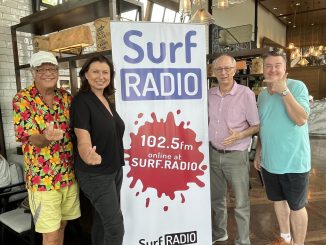
Thailand’s expat station Surf 102.5 FM rebrands to Surf Radio

Expat radio station Surf 102.5 FM in Thailand’s resort town of Hua hin has rebranded as Surf Radio. 
The station started life 20 years ago as an initiative of Pongsawatch Charoennithithat with a vision to provide English radio for expat residents and visitors to the area. 
The station initially experienced some success, but soon faced challenges due to inadequate signal, and poor audio quality.

In 2015, Richard Buckle approached the owner with a view to transform and rebrand the station as Surf 102.5. 
Local businesses actively engaged with Surf for advertising and local community groups soon asked for promotion of their events, Surf 102.5 continued to grow in popularity.
Today, Surf Radio has undergone a major overhaul in terms of equipment, antenna, audio processing and high quality streaming.
Programming has been refreshed with new jingles voiced by legendary voiceover Mitch Craig that compliment Surf Radio’s playlist of mainly 80’s and 90’s hits, plus a sprinkling of  2000s, new tracks and a few classic old favourites.
Surf Radio’s new website is optimized for use on mobile phones, and the Surf Radio player appears similar to a radio app. […]

ASIA

The Impact of Artificial Intelligence

Content from BPRThe subject of Artificial Intelligence (AI) and what it can contribute to media and broadcasting specifically is a topic so hot right now that pretty much by the time you finish writing an article about it, whatever you have written is behind the times.  We can look forward to a feeding frenzy of ideas and applications about how radio can utilise AI to enhance, extend and expand our content horizons so I am not going to delve into that but rather focus on the implications of AI and longer-term considerations.What got me thinking about this was a conversation with a friend who is about as far up the AI development food chain as you can get.  Admittedly not necessarily in audio applications but certainly in the higher-level applications of this amazing and slightly scary technology.

My first question was “So what is possible?” to which the answer was “Whatever you can imagine.”  This was quite a challenging response as I can imagine a lot, so I put to my friend the following.“What about a radio presenter with the topical edge of Howard Stern, the comedic timing of Bob Hope, the humour repertoire of Joan Rivers, the debating skill of Margaret Thatcher and which sounds like George Clooney”.My friend just smiled and replied “easy, so that’s all you want?”Well, it is not in fact as “easy” as all that, but it is entirely possible if the boffins have access to enough of the right reference data and modelling parameters.This prospect of engineering super AI personalities may seem fantastic, but it is comfortably within the remit of the technology.  The question is not so much what is possible but where we draw the line.  At present it seems the excitement about AI is moving well ahead of factoring the implications that may result.A recent example of this was the German magazine “Die Aktuell” which some weeks ago promoted an interview with Michael Schumacher stating the interview would “answer the burning questions that the whole world has been asking for so long”. However, the interview was not of course, with the real Schumacher but rather written by AI on a chatbot. To the horror of the Schumacher family the magazine sold it to their readers as a “world first”. The magazine even featured a photograph of a smiling Michael Schumacher on the front cover promoting the fake story. The Schumacher family are of course taking legal action and many wish them well in that pursuit.At this stage of the game no-one in their right mind can lay claim to knowing where AI is headed.  It is potentially the most expansive technology ever created because at a point it transcends human influence and becomes self-learning and self-developing if designed and allowed to do so.  It will not be a rabbit we put back into the hat easily because the commercial opportunities of AI will create such momentum and demand for the technology it will be a brave person who argues putting the brakes on and pausing to think for a while.So it’s not so much a matter of debating the potential and limits of the technology but rather the implications of the technology.In terms of broadcast some of the implications include:Copyright: What protections if any, will personalities have to their voice, content, style and personal story?Security: What protections will we need to prevent malicious interference, such as hackers accessing your AI traffic reports and turning them into a guide to Karma Sutra positions or a disgruntled employee deciding to leave you with a “special” message in the 7am news, read by your AI news anchor.Competitiveness: What if at the flick of a switch your competitor can have an AI personality that is funnier, smarter, wiser and knows exactly what “less is more” is all about compared to the real presenter you have that costs a fortune, never shuts up and is difficult to manage.Legal: What if a malicious interference leads to your station AI voice defaming someone or spreading false information.  Where does a station sit legally with that?  For some reason I think a defence of blaming the AI will not stand up in court.Listeners: What will listeners think about it all?  Will they even notice? Will there be a value placed on a real presenter or will they not care? Will it simply be about who entertains and informs them the best.Presenters: What does it mean to real presenters when they are competing against more knowledgeable, funnier AI presenters who never have “bad days”, deliver a perfect sense of timing, don’t take holidays, never get sick, have no problem filling a 6-hour show on a Sunday, do everything they are told and are cheaper?Radio’s Competitors: What does it mean to radio when our streaming competitors can replicate everything a radio station can offer with at least an equal degree of personality, content and localism?The main message is that while we all rush towards what AI can do for radio, pause a moment to consider what it may do to radio. This is not something you can stop or ignore. Look for the opportunities, protect against the threats, avoid the hype and pause occasionally to think.By the way, this was written by the real Wayne Clouten…not a Chatbot. Trust me, I’m a consultant.By Wayne Clouten, BPR […]

ASIA

Free podcast workshop for Radiodays Asia 2023 attendees

Attendees to Radiodays Asia 2023 can join a free workshop on Monday 4th September: How to design and plan your podcast by using the MethodKit for Podcasts. A workshop with DW Akademie and Public Media Alliance.Whether you’re an audio pro or just starting out, the MethodKit for Podcasts developed by DW Akademie can be used across every aspect of your podcast — from development to production to distribution to marketing or from audience growth to content ideation and more.In this session, you’ll learn how to use this new analogue and digital tool, as well as find out more about its development and how it’s being used globally. Furthermore, you’ll discuss about the value of podcasts in times of crises and how podcasts can complement breaking news.

The MethodKit for Podcasts was developed in collaboration with leading podcast experts from around the world and includes 61 cards designed to help you and your team discuss, map, plan, ideate & prioritise your podcast journey. The kit has been translated into 28 languages.More details, including how to book, will be released shortly. […]

ASIA

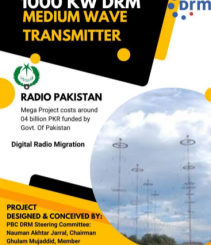
Radio Pakistan launches 1000 KW DRM medium wave transmitter project

On Sunday, July 30, Pakistan’s Minister for Information and Broadcasting, Marriyum Aurangzeb, launched the installation project of a 1000-kilowatt Digital Radio Mondiale (DRM) digital transmitter at HPT complex, Rawat, Rawalpindi, at a cost of 0.4 billion Pakistani rupees.She said the groundbreaking initiative, set to be completed within two years, marked a significant milestone in the Radio Pakistan’s history and would revolutionize broadcasting capabilities. She termed DRM Technology as inevitable to meet the needs of modern broadcasting as analogue and shortwave technology become obsoleted.This will increase the signal strength and coverage area of Radio Pakistan’s broadcasts to 52 countries in Central Asia, Middle East, Far East and eastern Europe, in addition to south Asia. Among the countries which would benefit from Radio Pakistan’s DRM broadcasts are Nepal, Bangladesh, India, Afghanistan, Iran, UAE, Qatar, Turkmenistan, and others.

Aurangzeb, who announced the project and its support by the government at the beginning of July already, underlined that the modern transmitter, based on DRM technology, will be able to transmit up to four different signals simultaneously. The minister said the new transmitter would thus enable dissemination of vital emergency information to all citizens during natural calamities.The sound quality of Radio Pakistan’s broadcasts would also be substantially improved, enhancing the overall listening experience for audiences. In addition, the use of the DRM technology would achieve significant cost savings for Radio Pakistan, with an estimated 33 percent reduction in electricity consumption.The Minister congratulated the whole nation on the launch of this complex project and appreciated the hard work the Director General Radio Pakistan and of all officials who put in their efforts to start it.She stressed that the Government’ decision to digitise Radio Pakistan after 75 years had been lauded by the international DRM Consortium. The inauguration is part of phase 1 of a three-phase DRM digitisation plan of the country’s public broadcaster; in effect, this signifies that Pakistan has embraced the DRM standard in all bands for the whole country. She also asked the Director General of Radio Pakistan to complete the project within one year, ahead of the two years stipulated time. […]