ASIA

India: Let there be independent news on private FM, says TRAI

The Telecom Regulatory Authority of India (TRAI) has released its recommendations on “Issues Related to FM Radio Broadcasting”.It has recommended that private FM radio operators should be allowed to broadcast independent news and current affairs programmes, limited to 10 minutes in each clock hour. The program code of conduct as applicable to All India Radio for news content may also be applied to private FM radio channels.Recommendations were sought by Ministry of Information and Broadcasting in May 2022 on the removal of linkage to Non-Refundable One Time Entry Fee (NOTEF) in the formula for annual fee as prescribed in the FM Ph-Ill policy guidelines and on extending the existing FM license period of 15 years by 3 years.In August 2022, representatives of Association of Radio Operators for India (AROI) also raised issues for consideration of the Authority, including permitting private FM Radio channels to broadcast independent news bulletins and availability of FM Radio Receivers in mobile handsets.At present, private FM players are only allowed to broadcast All India Radio’s news bulletins without any alterations.“By extending the scope of news and current affairs programming on private FM radio, the Authority aims to facilitate a comprehensive flow of information and promote the democratisation of media access. It recognises the potential of FM radio to bridge the information gap, particularly in rural areas,” TRAI said.The recommendations also state that the annual license fee of a FM radio channel should be de-linked from non-refundable one-time entry fee and the license fee should be calculated as 4 percent of the Gross Revenue (GR) of the FM radio channel during the respective financial year.Operators are currently required to pay an annual licence fee at 4 percent of the gross revenue of its FM radio channel for the financial year or 2.5 percent of NOTEF for the concerned city, whichever is higher.Functions or features pertaining to FM radio should remain enabled and activated on all mobile handsets having the necessary hardware. Built-in FM radio receiver in mobile handset must not be subjected to any form of disablement or deactivation.A Standing Committee, headed by a senior officer of Joint Secretary or above level, to oversee and monitor the compliance by mobile phone manufacturers (or importers) may be established by the ministry of electronics and information technology.Further, the government may take appropriate measures to provide relief to the FM radio operators to address challenges posed due to the covid-19 pandemic. […]
ASIA

Never ending evolution for radio ratings #RDA23

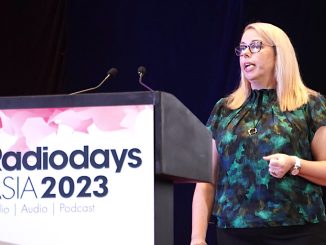
“Our radio audiences have never been stronger,” Commercial Radio Australia’s Chief Commercial Officer Jo Dick told the Radiodays Asia conference in Malaysia.“Digital audio is not just about Spotify, not just about Radio, it’s about Audio and its never-ending evolution,” she said.One of the huge achievements of Australian radio in the evolution of audio has been the development of the hybrid ‘Radio 360’ ratings system, which has brought a new level of confidence to agencies and advertisers about advertising on radio and podcasts, according to Jo Dick.CRA partnered with GfK in the landmark evolution of the ratings system from paper diaries to what is now a robust digital system that combines server side raw data feeds that show listening patterns from apps and live streaming with validation by electronic diaries and watch meters.GfK’s Deb Hishon (pictured below) joined Jo Dick in the presentation to explain how the system works.“The industry came to us and said ‘we need to evolve audience measurement,’ they wanted to maintain the integrity of what we do, but to evolve it further, so we took the best from all the tools available and created a hybrid system which has been live since June this year.”The Radio 360 system is made up of a combination of three measurement tools:
50,000 diary respondents, 80% of them using an online e-Diary and 20% still using a paper diary to reach those who cannot be reached online.
This is added to data from 200 station server logs, balanced by using census data.
And a national panel of 2000 people wearing a watch meter to validate the rest of the data.
What do we know now that didn’t know before?There has been “a significant enhancement to the old system” bringing more consistency in trends, and radio companies now know a lot more about what audiences are doing.
About one third of younger audiences are consuming commercial radio via streaming.
The shape of the day is different for those who listen to radio via live linear broadcast platforms and those who listen via streaming. Streaming listening peaks later and stays higher throughout the day.
Streaming is popular across all station types. Talk station listeners are streaming for longer, 6 hours and 38 mins.
12% of talk listeners and 14% of music listeners are streaming.
There are slightly different profiles between broadcast radio listeners and streaming radio listeners, so there is an opportunity for advertisers to create different streaming and broadcast campaigns and compare them side by side to see how effectively they can reach each audience.The industry can now use the data to show audio consumption at a moment in time. Hishon used the example of the Queens death, showing how radio listening increased as people heard the news and wanted to find out what happened. The new system can also track summer listening, showing that the total amount of listening is similar during summer holidays as during working year, but the pattern of listening is a bit different.The new Radio 360 ratings system is built for any market  and can be adapted and scaled to any size.Jo Dick said the new system has given Australian radio and audio “a competitive advantage, by being able to show the digital audience to agencies. Agencies are telling us they are pleased we are keeping pace with what advertisers demand.” […]

ASIA

Podcast of the Year Winners speak at Radiodays Asia 2023

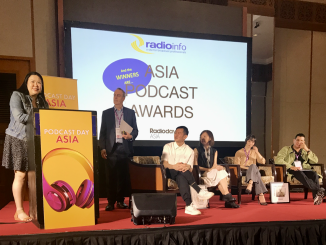
The awardees of the first ever Radioinfo Asia Podcast of the Year awards were invited to speak at Radiodays Asia 2023 in Kuala Lumpur.Radioinfo founder Steve Ahern presented the awards in front of an enthusiastic crowd on the second day of the event, dubbed Podcast Day by organizers.The winner of the major podcast award is the Japanese-American true crime podcast The Evaporated, produced by Campside Media and hosted by Shoko Plambeck and Jake Adelstein. The two hosts explore the Japanese phenomenon of jouhatsu – to disappear suddenly, literally evaporate– while also tracking down Adelstein’s missing former accountant.“We really think audio media and journalism share similar struggles with engagement and relevance, and this is just one way we see them evolving together for the future,” said the hosts in their acceptance speech.The indie podcast award winner is SPH Media podcast The Reading Room, a lighthearted, conversational podcast hosted by Tan Yi Li and Chang Cheng Yao. The Singapore-based Mandarin language podcast is described as being “for book lovers who like to delve beyond the book and at the same time enjoy anecdotes of life.” The Reading Room began from a conversation between Tan and Chang and grew into a project that has so far been running for 3 years. It introduces Chinese books from multiple different countries to readers.Tan also presented at the 25 Ideas In 25 Minutes event held in a later session, where she outlined her 5C’s of podcast success: Communicate, Collaborate, Consistency, be Creative and build Community.Also announced during the session were The People’s Choice Winners of the Radioinfo Podcast Asia Awards. The winning podcasts, Land Before Bedtime and Viva la Vida, received the most votes in a staggering pool of about 1,000 respondents.Radiodays Asia was held September 5th and 6th in Kuala Lumpur, Malaysia. The event is a collaboration between broadcasters in the Asia-Pacific and Radiodays Europe, which organizes the world’s largest radio, audio, and podcasting conference.Last year’s in-person event, also held in Kuala Lumpur, saw over 300 attendees from over 30 countries, and it is estimated that even more have come this year due to the reduced COVID-19 travel restrictions.Reporter: Amy Yoshida-Plambeck […]

ASIA

Podcast sales tips #RDA23

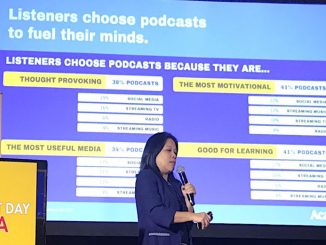
Timi Siytangco, from Acast Singapore, shared results from the Acast Sounds Smart Southeast Asia 2023 report about podcast listening and trends in South East Asia.When the aim is to monetise podcasts, data is one tool that can be used to persuade sponsors and advertisers.The report found that 53% listen to podcasts daily or multiple times in a week. This is equivalent to 30-120 minutes of attention daily . Podcasts accompany the listener through the day.Sales pitch tips:– People look forward to listening– Instead of passive listening people usually listen with focus.– People choose podcasts to fuel their minds – Brands can be part of the conversation, with authenticity and relevance“Remember that podcasts drive consideration, word of mouth and conversation,” said Siytanco.The Acast report is available here […]

ASIA

Podcasting possibilities in India #RDA23

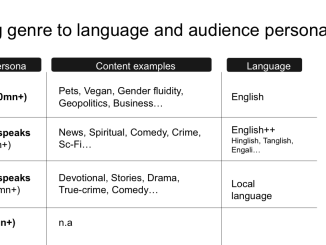
“Everything you say about India is true and also the opposite is true,” said Sreermaan Thiagarajan, CEO of aawaz.com, a podcast distribution company.“So there is an audience for everything and this applies to podcasts.” “We control the distribution of Podcasts and guarantee they are ‘Mom safe,’” he said.Thiagarajan has developed a framework that has been informed by the Indian audience data.He begins by asking, Who are the listeners, and has broken them down into 4 segments:
The 1%ees are the Globalised Indians (10 million+)
The “Desi” who speaks English (110 mil+) is the regular guy you meet in the workplace
The “Desi” who speaks an Indian language only (500 mil+)
The rest (600 mil+) have limited or no internet
Podcast listeners follow popular actors in Indian podcasts and the podcast platforms they use.He notes that YouTube is the real competition for podcasts as every age group watches content on Youtube.The main topics of audience interest in India include: stories, spiritual, news and comedy.The Content Framework for each audience segment is: Contact: [email protected] […]

ASIA

Drill down on data to discover differences in Asian podcast markets #RDA23

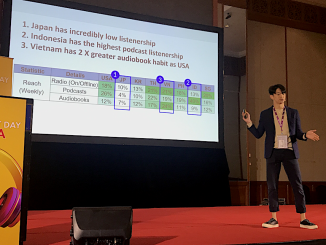
Guang Jin Yeo from Singapore, gave an overview of what works and what doesn’t across different podcast markets in Japan, Korea and South East Asia, also focusing on Asian podcast listening habits.Speaking at RadioDays Asia’s podcast day, Yeo based his analysis on recent GWI data sets. He believes that, “the time to enter the podcast market is now. The data shows that within 3+/- points (with the exception of Japan), podcasts have equal or more listenership than radio.”Drilling down on the data further he focused on Japan, Indonesia and Vietnam to explain the differences within the Asian market. Japan has the lowest podcast listenership, Indonesia has the highest podcast listenership and Vietnam has twice the audiobook habit of the US.One factor that has made a difference to growth is the regulatory environments in each country.“Japanese legislation makes it difficult to grow the podcast market,“ Yeo said. “Copyright infringement involves 10 years in prison, where as in other Asian regions it’s 5 years.”Indonesia is experiencing its ‘Serial moment of podcast awareness and rapid growth according to Yeo. “Indonesians keep coming back to listen to the chat style format, popularised by Deddy Corbuzier, who is seen as the ‘Joe Rogan’ of Indonesia.”‘Rintek Sedu’ is another podcast listeners have embraced as it connects with their emotional needs. One listener commented: “Life is complex so they laugh … and cry with Rintek Sedu”The Indonesian market also has less access to books, which is also a factor in podcast growth.A knowledge of cultural expectations also increases market understanding. “Vietnamese enjoy audiobooks because radio in Vietnam has always been scripted, which makes that style of audio compatible with listening habits. This contrasts with Indonesia’s off the cuff style of audio content, and Indonesia also has a strong culture of learning.”“The audiobook ecosystem in Vietnam shows that listeners who want to listen enough are willing to pay, that there is room for start ups that facilitate audio books,  and that there are writers keen to develop audio books,” he said.In Vietnam, the culture of learning also extends into podcasts. The top 5 Vietnamese podcast categories are: Education, Arts, Society and Culture, Business, Music.Other interesting podcasts in Singapore and Malaysia include: “The final take away is to unlock the next billion creators in the region by going deeper, wider and harder,” said Yeo.Related reports:Podcasting: Recent trends and future goals #RDA23 […]