
ASIA

How to Predict Your Competitors’ Next Move

Content from BPRThis title is from an article by the international consultancy firm, McKinsey.  The article centres around an interview with John Horn, author of the new book Inside the Competitor’s Mindset (The MIT Press, April 2023) and explains how to predict competitor actions. Horn is a professor at Washington University’s Olin Business School in St. Louis who helps companies maximize the value of competitive insights.The core message of his book is this:

The big idea is that many companies do competitive intelligence, but where they fall down is in turning that intelligence and data into insights about what the competitor will do. Many of my clients say that their competitors are irrational, but this is because they are not taking the time to look at the world from their competitors’ point of view. Once they do, those competitive actions start to make sense.Now I’ve written articles about Game Theory before. The mistake we in radio make in trying to predict what the leadership team at Station XYZ will do is that we base our predictions on what we would do if we were running the station..As John Horn says:One reason is that we assume our approach and the way we look at the world is right. When someone does something differently, it creates a dissonance with what we think is the correct answer. The other reason is that with more seniority, power, or status comes greater difficulty in being empathetic. We made choices that got us promoted, so we assume they had to be right choices. Any others don’t make sense to us.In my article “Game Theory Revisited” I said:Knowing what you would do in a certain situation is one thing. But the other key aspect of Game Theory is correctly defining what your competitors would do. This is not easy. You need the ability to reverse-engineer the moves of competitors and predict what they are likely to do, what they will avoid doing and what they are actually capable of doing.Getting inside your competitors’ heads is difficult because radio stations (and their decision makers) are usually very different. They often have different cultures, different theories on programming strategy, different budgetary pressures and always…..different talent in their line-up.John Horn has a four step plan designed to understand your competitors:The first step is to pay attention to what competitors say and do by downloading earnings calls or annual reports and scanning media releases. The second step is to find out what assets, resources, and capabilities they have. That’s where you start to differentiate the competitor. The third step is to consider the person making the decisions. What do you know about them? When someone with a marketing background becomes the CEO, they won’t suddenly start optimizing the footprint of factories. That person will likely focus on marketing to help the company grow, partly because they will think, “My background is why the board hired me.”The fourth element, which is really important, is making a prediction and then tracking it to see how it lines up with what happens. If you paid attention to what the competitor said and did, considered all its assets, and understood the leaders’ backgrounds, you can say, “I think they will do this in the next three to six months.” If what they do is in line with what you expected, you know you are on the right track. If you’re off, then go back and ask, “What did I miss? Maybe they engaged a new consultant or hired a new person to make decisions.” That updates what you pay attention to going forward to help you make better predictions. The objective is never to be 100 percent accurate, but it’s a lot better to be 30 percent accurate than to be 0 percent accurate in predicting what your competitor will do.Finally, he makes a very good point about where competitor insights come from:One of the challenges with competitive insight is that you can’t talk to your competitor, so you have to intuit outside in, from second- and third-party resources. A colleague of mine said, “It’s similar to a homicide detective who can’t ask the victim, ‘Who killed you?’”Most of us in the radio industry have worked for at least more than one network. We see the differences in strategic decision making processes and the varying internal pressures on revenue and resources from network to network that impact these decisions.As Sun Tzu said: “If you know the enemy and know yourself, you need not fear the result of a hundred battles. If you know yourself but not the enemy, for every victory gained you will also suffer a defeat. If you know neither the enemy nor yourself, you will succumb in every battle.”By David Kidd, BPR […]

ASIA

FEATURE: UNESCO celebrates 100 Years of Radio at The Radio Fest 2024 in New Delhi

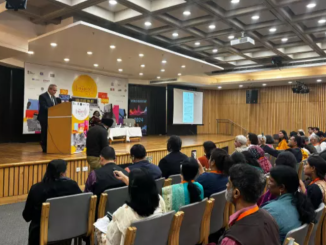
In collaboration with the Ministry of Information and Broadcasting, Prasar Bharti, and Seeking Modern Applications for Real Transformation, UNESCO New Delhi held ‘The Radio Festival’ at the India International Center on 13 February 2024 to celebrate the World Radio Day 2024. This year’s radio festival followed the global theme of “Radio’s remarkable past, relevant present, and promise of a dynamic future.” The inaugural session consisted of a letter sent in by the President of India, Droupadi Murmu, which highlighted the importance of radios in an ever-changing technological landscape as a conduit of gender equality and a revitalizer of local languages. “The World Radio Day is a celebration of radio in mass communication and in promoting the diversity of culture across the globe. It is an opportunity to emphasize the importance of local languages in communicating with the audience, and to highlight the extraordinary role of women in radio’s journey,” said her message.The other dignitaries who were in attendance were Sanjay Jaju, Secretary, Ministry of Information and Broadcasting, who, in his inaugural speech, spoke about the importance of The World Radio Day and the paramount role the ‘Radio Festival’ plays in highlighting the relevance of the radio in current times. His speech highlighted the importance of radio, especially as a means of information dissemination at the local level.

Vasudha Gupta, Principal Director General of All India Radio, concurred and added to the importance of the radio as a means of information sharing and sustained that “Akashvani, Vividh Bharati continue to serve the citizens of India in regional languages by sharing pure information, news, regional music and other programs on the radio and nothing can take place of the sound waves.”Tim Curtis, Director of UNESCO New Delhi, added to the importance of radio in his inaugural speech by commenting on its ever-changing importance in a dynamic technological world.“Studies show that radio remains popular despite increased challenges such as the popularity of social media. Therefore, it is only reasonable to expect radio to evolve and take advantage of these digital technologies. Its democratic value sets radio apart, and it acts as a grassroot catalyst for bringing communities together,” he said.The festival had multifarious panels to discuss the different aspects of the radio. Some topics discussed included gender equality and female emancipation in the radio space over the years, the linguistic influence of radio, and the historical relevance and its ever-changing future. The session on the Diversity of Sound, which RJ Nasir moderated, was particularly well received as it discussed the radio as a medium with a diverse array of audiences spanning different geographical, language, and expression. The festival had over 400 attendees, including members from a myriad of community as well as local and national radio stations and experts from the media industry.World Radio Day is an international UN day that was adopted by the United Nations General Assembly in 2012. 13 February, since then, has become World Radio Day to recognize the importance of the radio as a means of communication and technology and as an enabler for information dissemination and a promoter of human rights. […]

ASIA

ABC and Tonga Broadcasting Commission sign MOU

The Australian Broadcasting Corporation (ABC) and the Tonga Broadcasting Commission (TBC) have exchanged a Memorandum of Understanding (MOU), recognising their longstanding relationship.The signing of the MOU builds on the spirit of friendship developed over many years by the two national broadcasters, recognising the cultural significance of both organisations and their role in connecting and informing Tongan and Australian audiences.Under the agreement, the ABC and TBC acknowledge their shared history as public broadcasters championing the public interest and supporting democratic values across the Pacific region as well as their functions as emergency broadcasters, offering their citizens access to timely information in times of crisis.

The MOU underpins further collaboration and sharing of knowledge, content and technical expertise while welcoming the ongoing exchange of skills and strengthening of media practices.ABC Head International Services Claire M. Gorman said: “We’re thrilled to be undertaking this MOU with TBC, having worked together over many years. As public broadcasters, we share a mutual understanding of the importance of collaboration and offering informative, educational and entertaining services to our audiences.”TBC CEO Viola Ulakai expressed gratitude, saying: “We extend our sincere thanks to the Australian Broadcasting Corporation for their support throughout our enduring relationship.” TBC currently supports the ABC’s broadcast of ABC Radio Australia in Tonga on 103FM and is a partner with ABC International Development in media development initiatives in Tonga, aimed at developing journalism and content making skills to tell Tongan stories through Tongan voices. […]

ASIA

One day in Munich at Radio Days Europe 24: Natalie Diel, Gong 96.3

The Radio Days Europe ’24 conference schedule is packed from early morning til late night for the conference days so if you fly in early here are some suggestions of how to spend an extra day from a well known Munich Radio industry local.Morning show presenter Natalie Diel from Radio Gong 96.3 loves Munich!

The mountains and lakes around it and life in the city. Bars, restaurants, pop-up stores… She loves discovering the latest spots and trends for the radio and passing them on to listeners. And she knows what you should definitely see and do in Munich.We asked Natalie to give us her recommendations of what do do in Munich for anyone coming in for Radio Days. She recommends:Start the day with…A classic Weißwurst breakfast at the “Herrschaftszeiten” in the Tal. A young and fresh pub where you can enjoy a classic Weißwurst breakfast with pretzels and sweet mustard. And for those who don’t eat meat: It’s also available in vegan 😊https://herrschaftszeiten-muenchen.de/Sights, favourite places, insider tipsViktualienmarkt: Fresh flowers, the smell of coffee, lots to see. Not to be missed when visiting Munich.Marienplatz with the town hall and carillon…And then it’s up to the Alter Peter, the tower from which you can look out over the whole city… On a clear day you can see as far as the Alps…https://alterpeter.de/turmbesteigung-alter-peter/ A detour to the Bayerischer Hof, where most of the stars who come to Munich spend the night. From Michael Jackson, Robbie Williams and the Stones.From Odeonsplatz we take the U5 to Ostbahnhof, because this is where the Werksviertel-Mitte is located, a little insider tip for a visit to Munich. Everything here is very urban: small shops in colourful containers… Mostly Munich start-ups and brands. You can take a ride on the Ferris wheel… With a view of the sheep that live on a roof here in the Werksviertel 😊A coffee in between…at “Alrighty”, the new sustainable coffee brand made in Munich with its own roastery…https://alrighty.coffee/Dinner…at Fitzroy, an Australian restaurant with Munich’s highest roof terrace. You can eat delicious food on the glazed fronts and also have a spectacular view indoors…https://fitzroy-munich.de/You can round off the evening…From the very top to the very bottom 😊 In the cellar bar “Call Soul” in Schwabing in the English Garden. Here you’ll find the most unusual cocktails in town…https://www.callsoul-breakingbar.de/About Natalie DiehlNatalie Diehl gained her first experience in TV & radio during her studies in Munich and developed a passion that has stayed with her to this day. In 2005, she started as an intern at Radio Gong 96.3, Germany’s first private radio station. This was followed by a traineeship. She worked as an editor on the morning show for several years before switching to presenting the morning programme in 2015 and has been waking up Munich and the region every day between 5 and 9 a.m. and accompanying them into the day ever since. Speaking is her thing, not only on the radio but also at events or as a podcast speaker. […]

ASIA

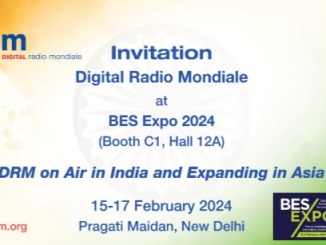
DRM at BES Expo India 2024

The Digital Radio Mondiale™ (DRM) Consortium is preparing for a rich and ambitious presence at the 28th international BES Expo (Broadcast Engineering Society) on Broadcast & Media Technology, under the title “DRM Expanding in India and All Asia”.With more than 1,000 delegates, speakers and panellists from India and abroad the BES event is rated the biggest in Asia. The BES exhibition and conference will be held in Delhi, from 15 to 17 February.Several of DRM’s Indian and international members and partners like CML Microcircuits, Fraunhofer IIS, Gospell, NXP, RFmondial and Starwaves will welcome visitors in Hall 12A – Booth C1. Other DRM members like Inntot (India) and Nautel (Canada) will also be close by.

Each of the participating companies will showcase the latest developments of the DRM technology as well as the progress made in providing high-quality and economical chipsets and receivers. The DRM C1 booth will be the stage for live DRM signal demonstrations highlighting the versatility of the standard.CML Microcircuits (UK, global) is introducing its new energy and cost-saving all-band receiver module announcing the creation of a consumer tester programme for its forthcoming DRM1000 receiver module. The testing process will ensure excellent consumer experience from the DRM1000 in the expanding DRM-capable receiver market in India. CML will invite up to 25 DRM enthusiasts andlisteners to receive pre-production module versions of the DRM1000 at booth C1. They will be asked to provide user feedback on features and performance of the module to CML, in return for free participation in the programme.NXP (global and strong in India) will also present its new powerful chipset (recently introduced at CES in Las Vegas and commercially available from 2025). Fraunhofer IIS (Germany) will introduce its latest innovation for DRM transmission and reception including DRM ContentServer and MultimediaPlayer technologies (available for manufacturer integration), as well as showcasing a series of applications turning the rich DRM standard feature set into useful hands-on experiences for users and listeners.RFmondial (Germany) is a company offering professional products and services for the digital broadcasting industry (DRM Multichannel, DRM-FM, DRM-AM). At BES it will highlight its major, tested innovations in providing superefficient DRM for FM broadcasts.Gospell (China) will show their latest small, integrated and superefficient receiver solutions. And receiver manufacturer STARWAVES (Switzerland/Germany) will demonstrate its newest and attractive receiver W2401 which can make the received DRM content and live streams available through its built-in Wi-Fi hotspot, as well as an exciting novel mobile solution. STARWAVES will also introducetheir local distributor in India.The BES conference held in parallel with the exhibition will include two DRM contributions on “Digital Radio – Ingredients of Success” and “Digitising FM – the Way to a Win-Win Solution”.For the DRM Consortium Chairman, Ruxandra Obreja, BES will be a great opportunity to show how much the standard has progressed recently not only in India but in other big and significant Asian countries. “Being able to demonstrate the DRM chain from transmission to reception will be the best showcase for the strength and versatility of the DRM standard. This will be a practical explanation forwhy an increasing number of important countries are investing in digitising with DRM in AM and FM.” […]

ASIA

FEATURE: Joint statement by EBU, UNESCO, AER & 12 world industry associations on #WorldRadioDay

This is a joint statement from EBU together with UNESCO, Association of European Radios (AER) and 12 world industry associations on World Radio Day 2024.Article 19 of the Universal Declaration of Human Rights, states: “Everyone has the right to freedom of opinion and expression; this right includes freedom to hold opinions without interference and to seek, receive and impart information and ideas through any media and regardless of frontiers.”World Radio Day 2024 marks 100 years of radio, a period in which it has become the medium that is arguably closest to human hearts and minds, providing news, entertainment and education in all corners of the world. It satisfies our need to be informed both for day-to-day decision-making and in times of emergency and crisis. Over the past century, radio has proved itself as a crucial medium in maintaining freedom of opinion and expression, often being the only one still up and running in times of crisis.

Studies have repeatedly shown that radio has the greatest trust, with most citizens rating it above television, the internet, social networks or the written press. Radio is a triumph of accessibility, immediacy and intimacy, and there’s a strong public-interest case for protecting it and our access to it.We believe that remaining easily accessible to all people, in all places, regardless of how they receive radio means using terrestrial broadcast networks (both analogue and digital) – still relied upon by the majority of listeners globally – and fostering online access to radio that is just as democratic and open.Cars are a particular concern, consistently among the most popular locations for radio listening. Whether it is terrestrial broadcast or internet, radio in cars should not just be easy to find, it must be impossible to miss.Information is a public good and a shared resource for all of humanity. Radio has its place in the digital transformation of the information ecosystem, complementing the internet and digital platforms. The evolution of communication technologies should advance people’s right to receive information and ideas through any media – instead of regressing it.We call upon governments, regulatory bodies, the technology and automotive industries, and all members of the global radio community to put safeguards in place to ensure that radio continues to thrive; to protect the free and unfettered access radio provides to a plurality of opinions and to trusted information; to allow radio to continue to help communities and all minority language speakers to receive information and participate in democratic processes; and to ensure radio remains available to all people regardless of their financial means or personal circumstances.Statement SignatoriesAcademia Espanola de la RadioAER – Association of European RadiosAIR-IAB – International Association of BroadcastingAMARC international – World Association of Community Radio BroadcastersAsia-Pacific Broadcasting UnionASBU – Arab States Broadcasting UnionCaribbean Broadcasting UnionCOPEAM – Permanent Conference of the Mediterranean Audiovisual OperatorsEBU – European Broadcasting UnionEGTA – Association of television and radio sales housesPublic Media AllianceUNESCOURTI – International Radio and Television Union […]