ASIA

New strategies to reach and grow audiences: RDE24

Day 2 of Radiodays Europe 2024 featured panel sessions discussing many of the biggest issues and topics for the broadcast industry. Radio executives from Sweden, Germany, France and the European Broadcasting Union came together to speak to the present and future for the stations they represent.Moderator Martin Liss started proceedings by asking the panel what they perceived as the greatest challenges and their response to it.Cilla Benkö is the CEO of Swedish Radio, a role she has held for the last 12 years. While the core business of radio is thriving, 180 jobs have recently been cut.Benkö said the challenge was to facilitate innovation and creativity within staff across multi platforms and making sure each area of their audio business was producing the best content to the market.Charles-Emmanuel Bon is the Secretary General of Radio France. He said that radio needs to “be clearer in how we promote what we do”. He saw one of the biggest challenges facing radio as enticing youth and suggested that there is an as yet largely untapped opportunity for audio and radio to be presented to parents as an alternative to screens with then those children the next generation of avid audio consumers.Mattias Pfaff the CDO of REGIOCAST said that with so many threads (digital/streaming/website/news/podcasts etc) now a part of one radio station it is essential to develop a strategy that fits your company rather than copies someone else’s. He spoke of two new production studios recently set up and opened in Hamburg and Berlin that are 2.4 square metres with an open kitchen so staff can cook together (this is a Scandinavian thing, he informed us). These small spaces are far removed from the traditional 300 square metre studios that would house a radio station. He feels smaller and more inclusive spaces both make people want to come into work, and are the way of radio’s future and the technology becomes increasingly mobile.Jean Philip De Tender is the Deputy Director General with the EBU based in Switzerland. He too said the lightning speed of changes to technology means radio both needs to be more mobile to move closer to their audiences and that the boundary between audio and video has vanished. He felt radio has learned from the past and is better skilled to adapt to change and quickly through effective strategies first, then implementing people and technology.Guy Fränkel is the Managing Director of rock stations ROCK ANTENNE. With a clear awareness of his male skewed audience he said focusing on your target audience was most important and building a community around them. He also made the point that with fewer jobs there was greater need for internal and external collaboration, sometimes being prepared to reach out to a competitor to find new ways of adding benefit to the listeners and broader audience.The conversation wrapped up with thought on what radio will look like in five years time and future strategies. Pfaff mentioned the smaller studios with Bon adding that stations will be lighter in staff, technology and floor space with silo management systems being eradicated and teams more cross functional, which is what was the norm for many of the older generation of broadcasters anyway.Benkö said stations will have no “spare parts” and it is likely with less hardware and more software that a physical house for a radio station may no longer be a necessity. She also said that Swedish Radio has got rid of all prerecorded audio seeing a point of difference in targeting people who don’t want to miss out by being present and on the ground.There was also discussion on the benefits of well run events featuring star talent, not just to the big cities but out to the regions with Benkö and Fränkel saying that such events they’d coordinated were consistently pack and excellent for advertisers and market building.Pictured L-R: Guy Fränkel, Matthais Pfaff, Jean Philip De Tender, Charles-Emmanuel Bon, Cilla Benkö and Martin Liss. […]

ASIA

Deep fake audio is coming to an election near you: RDE24

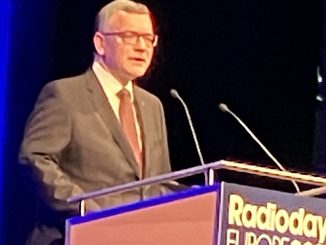
How much fake news do we face these days?The BBC’s first Disinformation and Social Media Correspondent, Mariana Spring gave a brief glimpse into the scale of fake news, not just on video, but also in audio.“Fact checking alone is no longer enough to battle all the fakes that are now available online.  The technology is available to everyone…social media companies are hard to hold to account,” she said, previewing a longer session she will present later in the conference called ‘My Life in Conspiracy Land.’“One thing I am very concerned about is AI generated audio. There are a lot of purported secret recordings, especially in countries facing elections in the next year.”She urged credible radio businesses to be on the front foot in interrogating this kind of fake audio. Spring is doing that in her podcast called ‘Why Do You Hate Me.’She says “take the audience with you on your journey to uncover these things, make it like an investigative podcast and explain why it matters to your listeners… Use the techniques of good journalism, work with a good team, go and see all the people you will cover and interview them properly face to face. Try to find out how people with conspiracy theories got there, what social media did they use, how were they drawn into the conspiracy.”“A level of hate higher than in the past, seems quite common now. When it happens to me, now I call it out and use it as a way to tell the audience how things are happening in these times.”Today marks the first full day of Radiodays Europe, with presentations across four simultaneous tracks for an audience of more than 1500 people from about 65 countries. Spring was one of the key speakers on the opening session.“Interest in radio and podcasts is very strong and the large audience here at Radiodays reflects that,” said CEO Peter Niegel opening the conference. The theme is ‘shaping the radio landscape.’“Radio is holding its reach, and new forms of audio such as podcasting are expanding our audience,” said Niegel.Katja Wildermuth, the Director-General or the regulator Bayerischer Rundfunk welcomed delegates to Bavaria, a region of Germany where there are 30 commercial radio companies operating, plus the public broadcasters.“Technical innovation and AI are part of our future, but, as well as technology, the magic of radio is still storytelling and the creation of relationships in a trustworthy credible way. This is more important than ever at this time,” said Wildermuth.“Radio has a future when the right people and the right ideas converge,” according to Germany’s Media Minister Florian Herrmann (pictured below).The Bavarian state government has sponsored the conference to bring delegates to Bavaria, where “radio is fun, and is also important for democracy. Radio creates people who are participants in an open democratic society, and it is also good business.”Lars Bastholm, the Founder & Principal of Bastholm Creative Consulting introduced one of the main themes of this year’s conference, Artificial Intelligence.With a short history of radio, the universe and everything, he resurrected Orsen Wells for a conversation and created a brand new world to promote the magic of radio… all through AI.“We have an opportunity to enter a new age of radio, we are entering a golden age of AI radio which will enhance what we already do.“The ability to create anything now is daunting, but also presents opportunities. AI can be done by everyone and can transcend language through translation tools… you can reach a really broad audience.” Ask for the AI toolbox and learn how to use it, get to know what can be done. “You won’t be replaced by AI you will be replaced by someone who knows how to use AI.”When using AI, Bastholm urges people to ask themselves, “what do we have that is unique to humans?” Some of the answers to that are:
People are weird, computers will never be as odd as humans.
Humans think sideways, not just lateral thinking. Computers can’t think sideways.
If we make mistakes that reveal that we are human, celebrate those mistakes and tell the audience about them, rather than being driven by the perfection that machines strive for.
Celebrate our humanity!
This slide of the hobby horse steeple chase, is an example of how weird people are. When he asked an AI engine to create a horse riding competition using hobby horses, the machine did not know what to do and produced no result. […]

ASIA

Transactional and relational sales techniques: Pat Bryson at RDE24

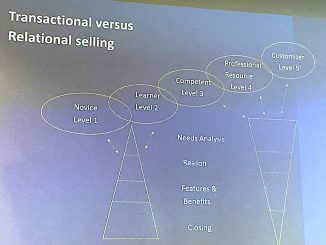
“It’s not about you, it’s about the client,” was Pat Bryson’s key message to the Radiodays Europe Sales Summit.“People buy for their reasons, not yours,” said Byrson. People will only do what they perceive to be in their best interests, you must locate their need (the why) before you present a solution.She explained the different need states between transactional and relational selling techniques. Relational selling fits your offering to the client’s situation.The diagram above helps guide salespeople on which method to use. Larger and more complex offerings are sold at levels 3, 4 & 5. Sixty percent of offerings are sold at the relational level.Some of the key questions to ask your customers so that you can work out more about their business and present a proposal that will suit their needs include:
What are the biggest challenges your business faces at the moment?
What do you want the advertising to accomplish?
Who are your target customers?
What budget do you need to allocate to us?
There are two key types of radio campaign: A sale or event, or branding and bonding. Determining what the client wants to achieve will determine which approach to take.Pat Bryson is a regular columnist for radioinfo and spoke, you can read some of her previous articles here. […]

ASIA

Using AI for radio sales: RDE24

“Why should you use AI for sales?” asked Herrman Del Campo of Zaibr.com, in a Radiodays session titled AI-Powered Sales Strategies for Radio Stations and Audio Companies.He listed the following reasons:
It can be automated
Personalised
Done by everyone
Work 24/7
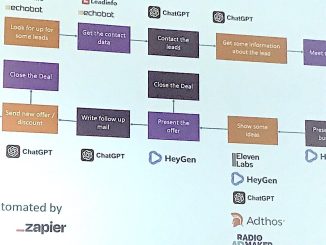
Del Campo displayed a sales flow chart and then suggested  AI programs that can enhance the work flow. For example, begin by looking up leads using Leadinfo or Echobot, then get some information about the lead using ChatGPT, Adthos, Radio Admaker and others.His sales work flow reflects all the processes in detail.Once you have decided on the process, you need to use the right commands to refine the AI output. Example listed below (click to expand slides).“Anyone can do this,” he told the audience. […]

ASIA

Brands using radio get back their money nearly eight times over: RDE24

“Radio will stay relevant in 2030…” said Christian Schalt, Chief Digital Officer RTL Radio Deutschland.“We need to understand the present challenges  for radio in order to understand the future challenges.”These present challenges include:
more competition and more digital stations means a more crowded market
new audio players
consumers’ time is competitive
Time spent with radio is decreasing. Younger listeners have a more rapid decrease. Although cume is going down it’s stable as it’s only down by 1% between 2021 and 2022.The good news is that radio will still be relevant in 2030 due to the following:
it’s position in cars
music discovery tool, radio retains top 3 position
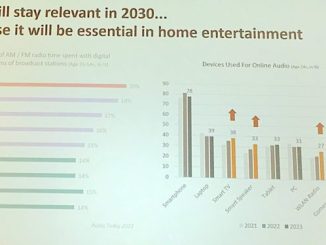
Schalt said the survey conducted by the Katz Radio Group (U.S) 2022 showed that radio advertising is highly effective as it’s also the least annoying medium in the advertising space. It’s also seen as the most trustworthy medium in Europe. The research shows that Brands using radio get back their money nearly eight times over on average.Another reason for radio’s continued survival is that radio personalities are influencers, just like influencers social media as 84% of audiences said they’d follow their favourite personality to a new station. When their favourite radio or podcast personality recommends a product 77% would try the recommendation.Radio will stay resilient as it will operate on more data. Data shows in real time how to monetise inventory, realtime KPI’s for spot monetisation.Radioplayer, more personalised app experiences and smart speakers will also play in role in keeping radio relevant.Schalt said that radio will be essential in home entertainment through the rise of the smart TV for mostly radio listening. Schalt quoted another 2022 study that 37% of online audio users who own a Smart TV use it for Webradio.AI can help reduce costs and add functional benefits by helping create content, market and sell plus broadcast, said Schalt.AI can add value to the chain by using:
Synthetic and artificial voices for reading news but not replacing DJ’s
Automated spot creation to make spots more affordable.
Artificial voices for speaking sponsor message e.g.. Tom Hanks contextual audio add.
Summing up Schalt says that radio will stay relevant in 2030 because:
It’ll be driven by data and insights
Strong in the car
Smart and connected
Highly effective for advertising
Leveraged by AI […]