ASIA

Podcast advertising leading the way in receptivity, attention, and effectiveness

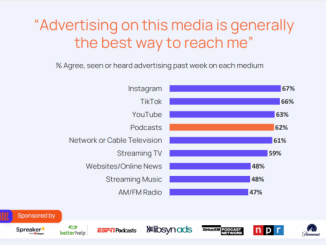
The Ad Bargain, a consumer study of more than 2000 Americans aged 18+ by Sounds Profitable, have looked at on the effectiveness of ad spends across TV, radio, podcasts and this year with an additional focus on YouTube and streaming CTV.The results largely show that the latter three, particularly podcast advertising, leads consumers to feel more positive about brands due to an ability to see the link between audio product creator support and the ads within.Tom Webster left Edison Research two years ago to partner with Bryan Barletta at Sounds Profitable.Webster said at the time:“Ultimately, Bryan and I have a shared vision to improve podcasting by tirelessly advocating for transparency, access, inclusion, and fair play. We want podcasts to be measured accurately and consistently.“We want the core fundamentals of the podcast business to be available to anyone who wants to learn them. We want creators and executives at the highest levels in podcasting to be as diverse as the incredible audience for podcasting. And we want podcasting companies and independents alike to be able to profit from their efforts in a fair marketplace.”The study yielded insights similar to one former CADA GM Emily Copeland conducted prior to the DAB+ station’s launch which she spoke of at this year’s Radiodays Europe convention. It also show how our feelings towards advertising and platforms we are most receptive to hearing branded messages from have changed.The Ad Bargain study showed Instagram is on top when asked, “Advertising on this media is generally the best way to reach me”. Radio is 20% behind Instagram and TikTok.Then, when you look at the relevance of the advertising to the consumer on each platform again Instagram is on top, with podcasting not far behind. This time the gap between Insta and radio is 30%.Most relevant to potential audio advertising is the next result of when the study participants were asked their willingness to consider a product or service when advertised on a certain platform. Podcasting led this, closely followed again by Instagram, YouTube and TikTok. Radio was around 50%.Further questions show that podcast listeners are more willing to purchase a product or service on a podcast because of reasons including:
Podcasts do not feel inundated with ads
Podcast ads, due to the above, are less objectionable
Listeners feel that by doing so they support the podcasts’ creators
There is some sense that podcasts protect a listener’s privacy more than YouTube or streamed TV advertising
They might go out of their way to support a product or service that similarly supports their favourite podcast
The fully study can be found here. It does appear that currently the balance between content, advertising, consumers and creators is largely working for podcasting. […]

ASIA

Reflector EVO Cloud Service on its way from StreamGuys

Streaming and podcast solutions provider StreamGuys have announced Reflector EVO, a cloud service for enterprise-level audio contribution and distribution that will be demonstrated at and available for purchase from the NAB Show 2024 opening.Developed in partnership with Barix, StreamGuys will lead all sales efforts and provide service hosting and 24/7 technical support for radio broadcasters, program syndicators and audio content creators that require a scalable, one-to-many cloud networking architecture for content delivery.Reflector EVO is the service’s second generation, developed 14 years ago to help broadcasters move high-quality audio over the internet. The original version removed network configuration challenges and made it simple to immediately send audio between studios and transmitters sites upon connecting a Barix encoder and decoder.Reflector EVO aims to be more affordable than satellite for syndicated delivery offering a highly available cloud service that can transport bulk audio streams to many locations at once, including uncompressed PCM signals with high bandwidth requirements.  Strengthened redundancy for mission-critical broadcast delivery has been added, with primary and backup streams operating in parallel to optimize signal integrity. The redundant streams borrow packets from each other as drops occur, ensuring streams are reassembled upon reaching end points.Barix has also updated its encoding and decoding hardware for additional network resiliency, along with enabling fast switching between encoders and adding support for lossless audio compression. Barix’s new LX400 broadcast codec, also at NAB, offers OPUS audio support for customers that want the highest possible audio quality and bandwidth conservation, with support for constant and variable bitrates (6kb/s to 510kb/s).The LX400 devices also include standard Barix AoIP codec features such as selectable input gain, relay support and contact closures, the latter of which allows broadcast networks to provide affiliates with precisely timed triggers for local ad breaks over EVO. There are also improved alerting applications ensuring that important notifications are prioritised for affected stations only, rather than being disseminated to all engineers in the network.Eduardo Martinez, the Vice President of Technology for StreamGuys said:“Reflector EVO isn’t merely an improvement on the original – it’s a reimagining of the infrastructure for the reliable transport of large media workloads, and modernized for today’s enterprise broadcast networks. With options for uncompressed transport, lossless compression and legacy compression, broadcasters have an array of options for high-quality deliver of speech and music and are assured a high level of service and consistent uptime for all cloud networking applications.”If you are at the NAB Show, April 14 -17 at the Las Vegas Convention Center, StreamGuys will demonstrate Reflector EVO at the ENCO booth (W1743). There they will also offer several service plan options across technical formats (compressed or uncompressed), hardware (purchase or lease) and support. […]

ASIA

Radio is Truly International!

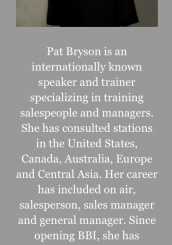
1500 broadcasters from around the world prove it.Selling Radio Direct with Pat BrysonSt Patty’s Day saw the opening of Radiodays 2024 in Munich, Germany. I was honored to be one of the speakers in this year’s lineup.Sunday began with several summits, the sales summit being one of them. That’s where I got to address a good group of broadcasters from over 100 countries. Although many stations in Europe are state owned, there are still independent commercial stations that are hungry to learn how to raise revenue in an increasingly complex business world. I hope they may have left my session with an idea or two to help them along their way.A large part of the conference was devoted to the topic of AI. What do we do with it? How do we integrate it into our stations? Will it make our jobs easier or non-existent? Sound familiar? These same questions are being asked daily in the US, Canada and Australia. World-wide broadcasters are learning to adapt and adopt.Podcasting was also a popular theme. More and more people are listening to podcasts. They can be an extension of our on-air products. We embrace them as another way to interact with our listeners.A lot of attention was paid to the latest studies on how radio works. And it does work! In the past few years, the number of studies seems to have accelerated and all reach the same conclusion: radio is powerful. Radio is everywhere. Radio enjoys more listening time in cars. It remains a favorite source for news, information and companionship.Radiodays provides 3 days of information about new products, new ideas. It also provides a chance to network with friends old and new from around the world. Over the years, I’ve developed great friendships with broadcasters from diverse countries. We get together once a year to renew our acquaintances, to make new friends, and to encourage one another in our craft.Wherever I go in the world, I hear the same concerns from radio people. We can truly learn from one another. I have also found that radio people share a love for the business. We are some of the most creative, intelligent and devoted people in any industry. We work hard: we play hard. We continue to innovate, to embrace change and new technologies and integrate them into our business.Is radio dead? No way! In fact, we lead the way in serving our listeners and our advertisers.I hope to be joining Radiodays next year in Athens, Greece. Until then, I will continue to promote the industry I love. Maybe put this on your calendar? March 9-11, 2025. It will rock your world! Happy Selling! […]

ASIA

CallerOne is waiting on the SIP line…

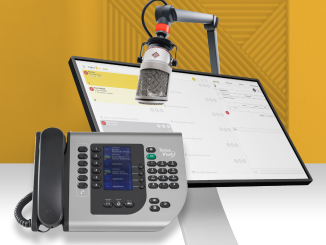
If you’re a broadcaster, on the tech and accounting side of things, chances are you’re facing the challenge of rising POTS line costs.Enter Broadcast Bionics with a more affordable solution called CallerOne.CallerOne allows stations to move to affordable SIP lines with minimal investment. New support for existing call control hardware from Telos and Wheatstone allows broadcasters to benefit from lower line costs while retaining their current call handling workflow.“Broadcasters who rely on POTS lines for their talkshow systems will be facing hefty price hikes, if not now, then very soon. But transitioning to SIP can be daunting, and what about those trusted VSets your talent loves?” asks Matt Collison, Brand and Marketing Lead at Broadcast Bionics. “Thankfully, there is now a simple and affordable solution,” he says.At the heart of CallerOne is a sleek, user-friendly interface that empowers on-air talent, call screeners, and producers to effortlessly manage calls and ensure seamless content flow. Additional call screening positions can be set up with only a browser and headset, and two on-air studios can share a single CallerOne system where needed.Broadcast Bionics innovative CallerOne software makes the transition to SIP painless, all while saving line costs, improving call quality, and opening the door to all digital has to offer.“CallerOne’s recent integration with Telos VSet allows stations to keep using the hardware and workflows they are used to, while at the same time transitioning to digital – we expect this to be an extremely popular solution!” says Mr Colllison.CallerOne will be on demo at NAB 2024 April 13 -17 on the Broadcast Bionics booth, C2030.For more details go to the website and contact your local distributors.AustraliaAVC Group – AustraliaP.O.Box 1005Mooney PondsVIC 3039www.avc-group.netTel: 1-800 631 728New ZealandAVC Group – New Zealand3 Ceres CtMairangi BayAucklandwww.avc-group.netTel: 0800 282 477 […]

ASIA

Taliban inaugurates three new stations in Herat, Afghanistan

The Taliban launched three radio stations – “Shariat Voice,” “Omid Voice,” and “Horiat Voice,” in Herat province last week, according to a spokesperson for the provincial governor’s office.Nisar Ahmad Elyas, the spokesperson, announced that senior local Taliban officials attended the inauguration ceremon.During the inauguration, Muhajir Farahi, the Taliban’s Deputy Minister of Publication in the Ministry of Information and Culture, emphasized the importance of media in the current era.“No one can ignore the media in the ongoing era,” Farahi stated, advocating for national and domestic media organizations’ access across Afghanistan.Elyas highlighted that Herat is home to at least 28 active media organizations, including television channels and radio stations.Interestingly, this development comes amid reports of increasing restrictions on the media by the Taliban.The Taliban governor’s office in Kandahar recently directed departments to avoid filming during meetings, labeling it as “a major guilt,” while the intelligence department in Khost province has instructed local media to disengage from facilitating contact with female audiences.Last month, two private radio stations – Shamla and Dehkada, were temporarily closed by the Taliban municipality on March 10 in Ghazni province in Afghanistan.Photo: Amu TV […]

ASIA

Radio Televisyen Malaysia celebrates 78 years

Radio Television Malaysia (RTM) celebrated its birthday on April 1, marking 78 years of commitment towards excellence in informing, educating and entertaining generations as Malaysia’s first broadcaster.In 1946, broadcasting in Malaysia began with the establishment of Radio Malaya. In 1963, the country’s first television network, TV1, was launched, followed by a second channel TV2 in 1969. Both radio and television networks were subsequently merged as the broadcast arm of the Ministry of Information and renamed Radio Television Malaysia (RTM).RTM operates from its headquarters in Angkasapuri, in the Malaysian capital of Kuala Lumpur. RTM’s radio broadcasts are in Malay, English, Mandarin, Tamil and native dialects, reflecting the country’s multicultural diversity.It currently manages six television stations and 34 radio channels throughout the country.ABU Secretary-General Ahmed Nadeem wished RTM a happy anniversary: “On behalf of ABU, I extend our warmest congratulations to RTM on its 78th anniversary. As the pioneering beacon of broadcasting excellence in Malaysia, RTM has not only shaped the nation’s media landscape but also contributed significantly to the region’s broadcasting heritage. Here’s to many more years of innovation, diversity, and public service broadcasting. May RTM continue to inspire and enlighten audiences across Malaysia and beyond, serving as a steadfast guardian of information, culture, unity and national identity.”Prime Minister Datuk Seri Anwar Ibrahim expressed hope that Radio Televisyen Malaysia (RTM) remains a catalyst for change and continues to uphold quality and fact. In a brief Facebook post, he also said that the country’s oldest broadcaster would remain the voice of the people. […]