ASIA

Broadcasters name A.I. as the industry’s number one priority: ABU-Rai Days Conference

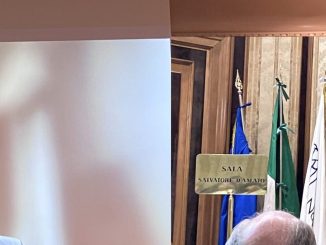
In Europe this week, public service broadcasters from Asia and Europe are gathered at the ABU-Rai Days conference to build a global perspective on Artificial Intelligence.The conference aims to unite decision makers, thought leaders and stakeholders from Europe, Asia-Pacific and Africa to understand how AI is reshaping the media landscape.Opening the conference, the Italian public broadcaster’s Chairwoman Marinella Soldi said, “in a world where dialog seems to be faltering, public service media needs to help citizens to form their own options in the context of knowing the complete facts.”To achieve this “requires trust between Public Service Media (PSM) and citizens. Trust must be built and earned through transparency,” she said. “Large language models and generative AI are changing the media landscape, so trusted public service broadcasters must join forces so they can move faster and become stronger together.”In his opening remarks, ABU Secretary General Ahmed Nadeem pointed out that just this week Apple has announced the integration of AI into its phones.EBU Deputy Director General & Media Director Jean Philip De Tender (main picture) told delegates the relationship between AI and broadcasters “is inspiring but sometimes worrying, but it never stands still.”“AI was introduced into broadcast companies to seek more efficiency, such as captioning and language translation… then we noticed the deeper storytelling ability of AI. Speech recognition software added inclusivity… Today AI is a multifaceted reality in the PSM space, including news.“It is used to deliver personally relevant content delivery. But the danger is echo chambers… we must guard against filter bubbles. AI is currently the EBU’s number one priority. “We don’t have the luxury to wait and see what happens, anyone left behind will fade into irrelevance… None of the benefits comes without risks, so regulation and governance guidelines development will be crucial,”  he said.De Tender said the EBU is collecting a series of case studies on how AI is being used in broadcasting. […]
ASIA

Digital Alert Systems and Inovonics partner on joint solution for external EAS monitoring gear

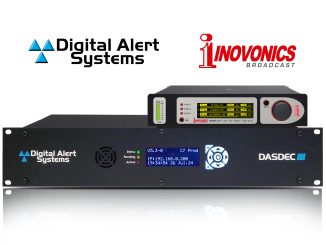
Digital Alert Systems, the global leader in emergency communications solutions for video services providers, and broadcast equipment provider Inovonics announced a new joint solution for broadcasters that want or need external monitoring receivers for their Emergency Alert System (EAS) devices.

“Working with Digital Alert Systems to integrate our two products will make EAS monitoring and rebroadcasting more robust and reliable for the broadcast industry,” said Inovonics President and CEO Ben Barber. “Having clean audio and reliable reception of EAS sources is not only good for our customers but also required by the FCC.”

The solution combines the Inovonics Model 677 AM/FM/NOAA Triple Tuner receiver with Digital Alert Systems DASDEC™-II, DASDEC-III, and One-Net™ SE models of emergency messaging devices. While the Digital Alert Systems DASDEC series offers the option of internal receivers, some customer locations or configurations require outboard or external tuners to monitor their required EAS assignments. In these applications, the Model 677 provides a compact, yet powerful set of receivers for those difficult situations.

The 677 Triple Tuner can interface easily with DASDEC-II/-III models. It provides a lot of flexibility, with three independent receivers to monitor any combination of AM, FM, and NOAA broadcasts. In addition, the 677 has a user-friendly web interface with remote monitoring features, such as notifications for reception errors and remote verification listening via audio stream.

With primary utility as an off-air monitor/receiver for EAS and NOAA emergency broadcasts, the 677 functions as a stable and dependable radio receiver and audio source for connecting to a DASDEC/One-Net device that either doesn’t have the internal tuner option or that might require a more robust tuner for challenging reception cases.

Digital Alert Systems has created an application note explaining how to connect the Model 677 to various DASDEC configurations in both dual- and four-input devices. This application note, titled “Using Inovonics Model 677 External Receiver with DASDEC-II/III,” is available here.  The document outlines the wiring between the two components, with several options depending on the specific DASDEC-II or DASDEC-III model.

“Not every broadcaster can use our internal tuners, so for those customers, having an alternate solution is crucial,” said Bill Robertson, vice president of business development for Digital Alert Systems. “Teaming with Inovonics on a complementary product that provides the best possible solution for our customers. The Model 677 is an excellent choice for broadcasters that either demand or require external receivers for EAS monitoring.” […]

ASIA

Can your prospect say “Yes”?

Selling Radio Direct with Pat BrysonIn working with my salespeople, I often hear, “The presentation went well but my client must take it to…(fill in the blank)”. One thing’s for certain, if we don’t have Mr. or Ms. Big in the room when we present, most of the time we won’t close the agreement. In fact, I think 85-90% of the time when we don’t close business it’s because we are talking to the person who can say, “No” but can’t say, “Yes”. That’s the person I call Mr. or Ms. Not-So-Big. It is common for businesses today to have multiple decision-makers or ultimate decision-makers in another geographic location. Getting to the “Yes” person can be difficult.Obviously, we must try to get Mr. Big involved at the earliest possible time. But what if we CAN’T get to Mr. Big? What do we do? There are several avenues we can employ with Mr. Not-So-Big to increase our chances of getting the sale.
First and most obvious, we can try to get Mr. Not-So-Big to arrange a meeting with Mr. Big. Ideally, that would be in the Phase Two Customer Needs Analysis meeting. Failing that, he needs to be in the presentation meeting. That can’t happen? Now what?
We can find out just how “sold” Mr. Not-So-Big is on our proposal by asking him, “On a scale of 1 to 10, 1 being you don’t like it at all and 10 being you have to buy it now, how sold are you on our solution?” He needs to be a 10+, completely sold on the proposal, or he probably can’t “sell it up” to his boss. Remember, if HE pushes our recommendation, and ultimately the boss buys it but then feels it didn’t work, Mr. Not-So-Big gets the blame. No one will risk their job to sell our programs!We can also ask Mr. Not-So-Big to authorize the agreement “contingent on” the approval of Mr. Big. This is another way to test his commitment.If he won’t sign the agreement, you can ask if he’ll write on the proposal, “This looks good to me. I think we should do it.”Another technique is to rehearse Mr. Not-So-Big for his meeting with Mr. Big. “Do you think Mr. Big will have questions about this campaign? What do you think they might be? How will you answer these questions?” In other words, you rehearse his answers with him to these possible objections.As you go through this process you’ll get a feeling about how likely it will be for Mr. Not-So-Big to be able to sell this to his boss. No one can sell our campaigns like we can, but sometimes Mr. Not-So-Big has to serve as our proxy. Get him ready to carry your message forward.Happy Selling!Main Pic: Shutterstock […]

ASIA

India’s Red FM returns with Quiz India Movement

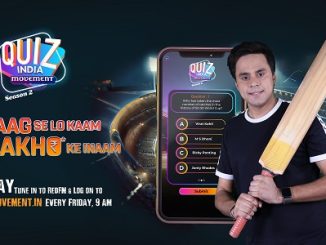
India’s Red FM announced season 2 of the Quiz India Movement, a celebration of India’s unending curiosity, thrill, and sharp intellect.The contest began on May 29 and will run till June 29,  alongside the T20 World Cup.National Content Creator Award winner RJ Raunac,  will host the show.The first live quiz is scheduled for  June 7 and will be a weekly event every Friday until  June 29. Each question in the live quiz awards Rs. 21,000, and there are weekly bumper prizes of Rs. 1,00,000 for a few lucky winners. Additionally, the powerplay section offers more opportunities to win big.Speaking on the announcement, Nisha Narayanan, Director & COO, of RED FM, and Magic FM, said, “Last year was the first time that a radio network introduced live broadcasting in gaming and the unprecedented success of Season 1 of Quiz India Movement made sure we brought it back for Season 2. Our objective with QIM has been manifold, establishing QIM as an IP that sets the gold standard for quizzing in India and blending the power of radio and digital for the ultimate user engagement experience. Incorporating an engagement hook that brings the audience back every day to play was also a decisive factor in creating the Quiz India Movement. Season 2 is based on the T-20 World Cup and the seasons to follow will have varied themes. We are looking forward to our audience’s continued love.” […]

ASIA

Suria FM scores a win at Asia-Pacific Broadcasting+ Awards 2024

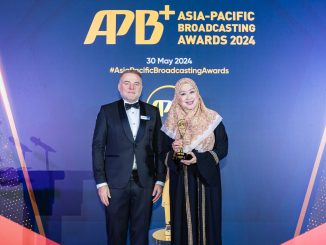
Malaysia’s Suria FM won international recognition with an award in the ‘Live Event Radio Streaming In Malaysia’ category at the Asia-Pacific Broadcasting+ Awards 2024 held at Singapore on May 30.The Malay-language station won the award for Jelajah Suria 2023 programme. It was received by the station’s general manager DJ Lin.The Asia-Pacific Broadcasting+ Awards is an event that aims to recognise innovation and excellence in projects that advance the broadcasting industry through content, innovation & digitalization. This program is open to all broadcasting companies and industry partners around the Asia Pacific region.Expressing gratitude for the recognition, DJ Lin said: “I believe that this success is the result of the efforts and commitment of my men at Suria FM who are committed to producing quality products and content for all our loyal listeners. Thank you to Asia-Pacific Broadcasting+ for this award, as well as to the Solar listeners who have always inspired us to continue to innovate in the world of radio broadcasting. This success would not have been possible without the strong support of all of you.” […]

ASIA

Embracing Digital

Content from BPRFor the past century, radio’s primary method of delivery was by radio waves – amplitude modulated and frequency modulated signals. In order to hear broadcast radio transmissions, listeners required radio receivers. In the early days, these were big bulky devices but technological developments in the mid-20th century allowed radios to become much more portable. Battery-powered transistor radios could now be taken to the beach!The 21st century marked the start of the digital age and with it came a host of cable and Internet-delivered audio and video.  What was radio to do? The initial response of radio broadcasters went something like this: “We’re radio! Our listeners can hear us wherever they go. They don’t have to pay a thing to hear our programs. Nothing to worry about!” Then came Spotify, Apple Music, Pandora, Tidal, Amazon Music and You Tube.
Whether we like it or not, our love affair with radio transmitters may be coming to an end. The good news is that listeners can now hear our programs digitally. For portability, nothing beats the smart phone and radio broadcasts are easy to find if the listener knows where on their smart phone they are located.
Our monopoly of audio content has long passed. However, radio is still competitive if we make accessibility to our programs obvious to existing and potential audiences.The following steps can help to make your transition to digital a bit easier.
Teach listeners how to access your programs in ways in which they perhaps are not familiar. A simple example is to tell listeners that they can listen to your station on any device that accesses the Internet.
Radio programs no longer need to be heard in real time. Make your breakfast program available at any time during the day. Special programs should also be available beyond their specific broadcast times.
Make yourself visible. Think beyond audio and embrace visuals. Listener loyalty can be enhanced if listeners can make visual connections with your air personalities, programs, and services. Your website is the perfect place to do this.
Give listeners incentives to move beyond traditional modes of transmission. Create and promote programs and services unavailable via AM or FM.
Programs and services available only digitally offer value added to advertisers and create new sales opportunities
Promote, promote, promote! In this new media environment, radio’s best hope for survival is to move into a digital mindset and bring our listeners along with us. Our top promotional priorities should be directed toward this end.
By Andy Beaubien, BPR […]