
ASIA

Malaysian government set to regulate social media with licenses

The Malaysian government is set to go ahead with a regulatory framework which will make licenses mandatory for all social media and instant messaging platforms.According to the Malaysian Communications and Multimedia Commission (MCMC), the framework was introduced to combat the increasing cases of cybercrime, including online fraud and gambling, cyberbullying, and sexual crimes against children. It will come into effect on January 1, 2025.“With the enforcement of this framework, all Internet messaging service providers and social media service providers with at least eight million users in Malaysia must apply for an Applications Service Provider Class Licence under the Communications and Multimedia Act 1998 (Act 588). Any service provider operating without a licence after this period is committing an offence and appropriate legal action can be taken,” it said in a gazette notice on August 1.If convicted, the service provider can be fined up to RM500,000, or face imprisonment up to 5 years, or both. The platforms can be liable for a further fine of RM1,000 for every day during which the offence is continued after conviction.During the grace period (August 1, 2024 to December 31, 2024), MCMC said it will develop comprehensive guidelines detailing the conduct requirements and responsibilities that must be proactively adhered to by the said service providers in Malaysia.The move has raised concerns from the Asia Internet Coalition (AIC), an organisation representing tech giants like Meta, Apple, Amazon, Google, Yahoo, Rakuten, X, and LinkedIn.AIC has issued an open letter to Prime Minister Anwar Ibrahim to raise concerns about the latest framework and urged the government to pause it and consider how it aligns with its broader economic goals before implementing it.It believes the framework introduced by the MCMC is unworkable for the industry and will adversely impact innovation by placing undue burdens on businesses. It added that the move would hinder investments and deter future ones due to the complexity and cost of compliance.AIC also says the proposed implementation time leaves the industry with insufficient clarity and inadequate time to fully grasp the implications.Communications Minister Fahmi Fadzil responded: “AIC does not represent all companies, just a few, and there are also others that are unrepresented. They are big tech, but our laws are bigger, and if they want to operate in Malaysia, they have to respect and comply with the requirements.“The Malaysian government still stands by our position that social media and instant messaging platforms need to have a regulatory framework to ensure a safer internet landscape for Malaysians, especially children and families.”Expressing his willingness to meet with any parties regarding the licensing requirements, he said: “We will continue discussions with companies. We have yet to make a final decision, and Malaysia is very open to discussions.” […]

ASIA

How mowPod helps podcasters get more audiences

mowPod is a podcast ad platform from newsletter marketing company MowMedia. It uses programmatic ad tools and data integrations to help podcast owners — including both large media clients and branded podcasts — drive engagement and downloads of their audio content.mowPod promotes podcasts by buying display ads on websites. These ads are then optimized and strategically placed across the web, steering listeners right back to a podcast. Podcasters can also pull comprehensive campaign reports straight from the platform, delivering insights on audience demographics, devices, daily delivery statistics, creative performance, and even granular geographic data.mowPod works with many of the largest media and podcast brands out there. From the Oprah Winfrey Network to Warner Media Group and the Hubspot Podcast Network, the most well-known media brands trust mowPod to run its podcast growth advertising with white-glove treatment.mowPod has also made its podcast ad-serving technology available to smaller, independent podcasts in a self-serve manner. Their system will create and place the ads, let the client set a budget, and allow them to log in to monitor the ad campaign’s progress for as little as $100. It will even allow you to quickly and efficiently promote future episodes in under 1 minute of setup.It will show you how many impressions your ads are getting on the open Web, how many result in a play and an IAB download. It will break down your ad campaign by the day or by the hour along with additional statistics, such as top devices, operating systems, locations of your listeners and more.The company offers both an enterprise-level and a self-serve product. mowPod offerings include:mowPod Boost: Hyper-targeted audience growth for podcasts on a fixed cost per 60 second download.mowpod Boost Self-serve: The first AI driven self-serve marketing platform to drive podcast discovery and listenership on a fixed cost per 60 second download.mowPod Apple Sub: Engaged audience growth in Apple Podcasts on a fixed cost per follower.More info at mowPod.com […]

ASIA

30 ideas in 40 minutes at #RadiodaysAsia

One of the most popular sessions of every Radiodays conference is the 30 Ideas session.It’s  a quick summary of the top ideas from some key conference sessions.These are the 30 ideas from 2024:Yumie Yoshiba – NHK1. Identity – Radio is identity. 2. Offensive – This is time to be more offensive3. Useful, Interesting and Fun – Work on the fundamentals as the main key points of radio4. Be a good partner with AI5. Cross over – Whatever platform you on we can find a way to collaborate for creating.Chris Marsh from SCA Australia’s Hamish and Andy Show
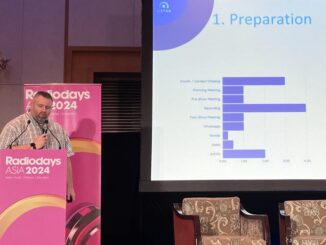
Preparation is most important: Follow Hamish and Andy’s success formula that 70% of your time is spent on prep. In meetings, talk about content first, save the business for second, then do the fun stuff last.
Team is so important: Half of the work is on the team, the other half is on the content. Spend enough time on building and maintaining your team.
Authenticity – Don’t rehearse too much, allow for spontaneity in your on air content. Hold each other up in the spontaneous moments, don’t kill the content or the momentum of your on air partner, take it forward.
Respect your audience – Make them fell like they’re in your club, build unique experiences for your audience.
Quality over quantity – Know the shelf life of your content. Not everything makes it to air, dump anything that is too old or not up to standard.
Harry Locke, Public Media Alliance
Go local and love the small numbers. If your content is having an impact small numbers might not be the only measure of success.
Obsess over good audio
Collaboration – do cross promos across podcast shows, collaborate with other areas, for example public libraries as they do in Canada.
Accessibility – AI may help radio reach people who might not normally have accessed radio, for example speech to text for sight impaired people.
Put ‘responsible’ before AI.
Emily Kwong NPR Host of Short Wave + InheritingWhat is the oldest technology powering everything you do? Your brain.1. Get enough sleep2. It’s okay to sleep late3. Your only as good as your last byline (Katherine X Lewis4. Show your sources your story5. Plan for nonsenseWade Kingsley, Creative Coash
Bring people together, like Taylor Swift. Don’t think ‘audience’ like one to many, think one to one and create a community of those people.
Make mistakes on purpose like Thomas Edison – try things that may not work but will lead you to learn something. Creativity doesn’t follow a rule book.
Create your own flow like Billy Ilish
Make it funnier – keep trying to make it funnier don’t just stop at the first funny line
Surf any wave you can – try anything.
Mike Russell: Embrace the future of audio creation1. Dream big and embrace AI tools2. Embrace AI for Automate repetitive tasks3.  Personalise listener experience for you in radio and podcasting4. Go and brainstorm with AI, (download pie.ai to organise your thoughts)5. Consider AI ethics […]

ASIA

WINNERS of the 2024 Asia Podcast Awards

The moment you’ve been waiting for is here.The winners of the 2024 Asia Podcast Awards are…

Category
Entry

Best Children’s Entertainment Podcast: Major
Chinese Folk Tales

Best Education Podcast: Major
Takeaway Chinese

Best Education Podcast: Indie
The GlobalEd Podcast

Best Factual Podcast: Major
Climate Connections

Best Fictional Podcast: Major
Pontianak

Best Fictional Podcast: Indie
Ghost Maps

Best Health and Wellness Podcast: Major
Thank Fitness it’s Friday

Best Interview Podcast: Indie
A Vietnam Podcast

Best Interview Podcast: Major
Muzik Roundtable

Best Money and Business Podcast: Major
Money Talks

Best Money and Business Podcast: Indie
The Financial Coconut

Best New Podcast: Major
Gen Bridge

Best News Podcast: Major
Big Take Asia

Best Radio Show Podcast: Major
Liang Wenfu Music Journey

Best Society and Culture Podcast: Major
Love Buzz

Best Society and Culture Podcast: Indie
The Daily Ketchup

Best Sport Podcast: Major
Suited & Booted

Podcast Audio Producer of the Year: Major
Huang Rui: Biodiversity Day Special

Podcast Audio Producer of the Year
Niall Mackay

Podcast Executive Producer of the Year: Major
Hou Limei: Growing up at the Yellow River Headwater

Podcast Host or Presenter/s of the Year: Major
Michelle Martin – for Presenter of the Year

Podcast Host or Presenter/s of the Year: Indie
Filming in Thailand – Stephene Lambert

Podcast Publisher of the Year: Major
CGTN Radio (Tie)

Podcast Publisher of the Year: Major
SYOK (Tie)

PEOPLES CHOICE

Best Money and Business Podcast: Major
Unibizity

Best Education Podcast: Indie
The Guiding Voice

You can click through from the winner’s tile to listen to each podcast.Winners are awarded in Major and Indie categories.Back to Top.Judging NotesThis year the judging panel had to make some difficult decisions. Not all categories were awarded both a Major and an Indie winner and one categoriy there was a tie.Majors are large podcast publishing companies that publish more than 5 podcast series per year. Indies are small podcast companies, sole traders, individuals, students and not-for-profits that publish less than 5 podcast series per year.Judges did not mark any entries associated with their own companies and did not see any of the marks given by other judges. Each category was judged by at least three judges. Judges did not know who else was judging their assigned entries.The People’s Choice Award, won by Unibizity and The Guiding Voice, was a popularly voted award open to podcast listeners and fans. People could only vote for one finalist and could only vote once. Over 5000 votes were recorded this year.The winners were announced on Tuesday 3 September at RadioDays Asia 2024. RadioDays was not involved in any stage of the judging process.Over the next few weeks we will feature some of the winners in separate stories here on Radioinfo Asia, based on information from their entry submissions. If you think you have a good story to tell about your podcast, please don’t wait for us to contact you, just email us more details to [email protected].The judges were:

Adam Sulaiman Bin Abdul Rahman

Blythe Moore

Cheong Yuen Wai

Darcy Milne

Flavia Voinea

Jake Adelstein

Matthew Durai

Rui Huang

Sharaad Kuttan

Shoko Plambeck

Sian Gard

Stanley Lim Chiang Hong

Steve Ahern

We thank all our judges for their diligent hard work to bring you the best of Asian podcasts for 2024.Congratulations to all our finalists and winners. You have made your contribution to podcasting in Asia this year! […]

ASIA

I could not talk about my uncle’s death: RJ Vijdan Saleem #RadiodaysAsia

In a session hosted by the Pubic Media Alliance, RJ Vijdan Saleem, a Radio Mirchi radio jockey from Kashmir told a story of an entertainment radio presenter who was faced with breaking news of his uncle who was shot dead during his debut radio shift. Then revealed the story was about him.His uncle was a journalist who was the victim of the continuing territorial tensions in Kashmir. Due to radio broadcast regulations in India, presenters on commercial entertainment stations are not allowed to broadcast or discuss news stories.“I could not talk about it because, due to regulations you can’t talk about news directly or indirectly. So how did I talk about it? I talked about my uncle’s death and played music suitable to my emotions, but was limited in how I could talk about the wider issues.”

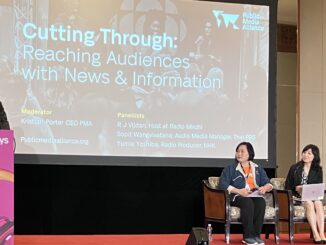
Vijdan has been disciplined and was taken off air for 4 months at various times due to some of his comments, but hen still feels it is important for him to reflect what the audience is feeling at times when violence breaks out or there are internet bans or other troubles in the region.“There are days when my city goes silent, but I can’t talk about it… At those times I try to reflect the mood of the city. I can’t discuss a murder, but I have to reflect the mood of my people. “This is the biggest challenge I face. I navigate it through music, stories and words that resonate with my audience’s feelings. I can’t be going ‘ha… ha… ha’ when my city of facing something hard, yet I can’t speak about news.”He says India needs to “broaden the canvas” and allow news on radio. “We will still entertain you, but we would have more things to talk about,” he says.PMA’s Kristian Porter says the challenges facing public service media are growing, which is why the conference session is looking at stories from the region that highlight the challenges and solutions media companies are dealing with.“In many places audiences are tuning out from hard news content… the media ecosystem is increasingly cluttered. The fight to cut through is becoming more difficult. Part of the challenge lies in more competitors such as streaming services and even gaming platforms. In this ecosystem radio needs trust to thrive.”The Public Media Alliance is the largest global association of public broadcasters, it’s mandate is to support and advocate for public Service Media. Media freedom, journalist safety and knowledge sharing are some of the key advocacy areas for PMA, which also has a podcast.Yumie Yoshiba (pictured above) from Japan’s NHK talked about strategies to attract young listeners. One of the most effective strategies is streaming and catch-up radio.She showed a graph of live listening (red) and catch up audio (blue). In 2022 the number of people using online audio catch-up overtook the number of people listening to live radio streaming in her company, the Japanese national broadcaster NHK.“There is more potential for radio to reach audiences with catchup audio, especially young people on mobile devices… Radio is not an old medium,” she said.Other examples from NHK are the ‘News Pekopa’ show, hosted by two comedians, and a show by two hosts from a boys music group. “We use influencers and artists to increase our young content.”NHK also visualises radio on tv with a once a month tv show catching up on the music group’s radio shows.“Information is presented in an easy to understand way, to respond to young people’s questions… At first fans of the boys group sent messages to the artists, then we saw an evolution of the fans… now they want to talk about issues as well as to talk about stars and music. Very good questions are coming to the program now, we didn’t expect it.”“When you talk about things that resonate with your audience trust is built. Don’t betray your audience,” said Yoshiba.In Thailand, Thai PBS began as a online station, then expanded to partner with other broadcasters such as community stations to rebroadcast the Thai PBS programs. Twenty years on the broadcast still has not had success to expand to broadcast frequencies, but, due to smartphones and the growth of streaming, “people have now found us on streaming and podcasts,” said Sopit Wangvivatana from Thai PBS podcasts. […]

ASIA

Radio remains resilient, a reliable source of news and a platform for cultural expression: #RadiodaysAsia

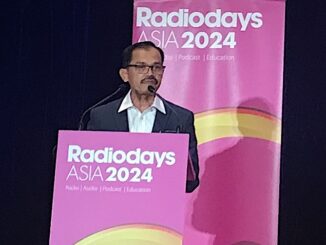
Commercial Radio Malaysia president Nasrin Nori (pictured) welcomed delegates to Kuala Lumpur for Radiodays Asia 2024, saying: “Radio has always been a big part of my life as it is for many of you here. “Just days after celebrating our national day we welcome you to Malaysia. Radio is woven into the fabric of our lives in this country, but the landscape is evolving faster than ever.”As CEO of Media Prima, Nori says his stations are “not just keeping up, we are innovating.”

“As we move forward it is crucial that we stick to our roots as well. Our strength lies in our diversity, we broadcast in many languages to reach every corner of Malaysia so that they feel heard and included.. Race, religion, royalty are core values in Malaysia, how we handle these sensitive topics is important and we need to project unity as well as diversity… The ongoing crisis in Palestine is a stark reminder of how the world is connected and this touches us here, affecting advertising revenue.”Turning challenges into positives, he explained: “We have one of the best traffic jams in the region, which is good for business because it increases radio time spent listening…  in KL we have also had leadership changes and media has had to adapt to those governmental changes as well.”“Radiodays Asia has become a meeting place to share ideas across the region and beyond,” said Datuk Mohamad Fauzi Bin Md Isa, the Chief Secretary Minister of Communications, opening the conference.“The importance of this event cannot be overstated, as we stand at the cross roads of technological change and shifting consumer habits. In Malaysia, Radio is a trusted companion in our daily lives that connects our diverse community. “As technology shifts we must adapt and evolve while preserving the core values that have made radio an indispensable part of our lives. The coming of AI has made the landscape more competitive than ever before. In Malaysia we understand the need to ensure the talent and connection of radio remain paramount into the future to enrich the tapestry of our nation.”“Radio remains resilient, a reliable source of news and a platform for cultural expression,” he said.Radiodays CEO Peter Niegel told the 300 conference delegates about the energy in the Malaysian economy at the moment.  “Kuala Lumpur is part of one of the fastest growing economies in the world.”“We have one of the oldest and one of the most loved industries in the world. Radio keeps coming with new ways to reach our audiences in this digital age. It is our job to make the most of those opportunities.“Our focus in this year’s conference is identifying new opportunities for audio. While audio still remains strong, there are many new challenges. Radio holds its reach and podcasting is growing, but we need to constantly reinvent ourselves to remain relevant, to do that we will need to work with new technologies such as AI.”Artificial intelligence is one of the topics in this year’s conference.ABU Head of Radio Olya Booyar (pictured) said radio’s challenges are not unique.“Everyone is struggling with change, we are no different from other industries. ABU members rely on technology as much as everyone else. Moving audiences to new platforms and improved production tools such as AI is important. Audiences make ever increasing use of their smartphones. “We need to adapt to all the new tools, but we also need to remember that trust and reputation are some of the most needed characteristics in a crowded and sometimes fake media market…“Radio of my parents generation is well and truly dead, but radio of the next generation on platforms we cannot yet imagine, has a bright future. For instance, podcasting has proven that long form content is still in demand… “Tap into the collective experience of everyone here and learn how to dominate your market before everyone else does,” she urged conference delegates.The conference continues in KL for the next three days. […]