ASIA

Major broadcast software company cuts ties with Russia

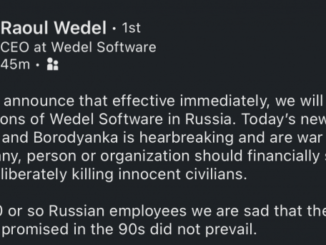
Amsterdam based Wedel Software which launched the Adthos brand last year, has suspended all operations in Russia where it had conducted much of its R&D for many years.Company founder, Raoul Wedel posted the following statement on social media a few days ago…Questioned about the impact this decision will have on the company and staff, Wedel replied, “We have had a part of our R&D in Russia for 8 years and actually before that in the Ukraine for 5 years. I have been in the region many times and have many friends an connections there.“The decision was on one hand heartbreaking, on the other hand I feel we have no choice, and people must unite against these war crimes. We have employees in Donetsk, Rostov on Don, Moscow and St. Petersburg. None of them supports this war, and they are just trying to provide for their families. “The decision will not affect our company in the short term, but we will need to regroup our R&D in the near future. Even if the war would end soon, the country will remain unstable and sanctioned as long as Putin is in power.“I hope this story will make more companies consider cutting all their ties with Russia,” said Wedel. […]

ASIA

Afghanistan: Four stations in Logar may close down

According to a report in Pajhwok Afghan News (paid subscription), four radio stations, including a state-run one in central Logar province, may shut down due to lack of income and government’s support.Shafiullah Afghanzai, head of Independent Journalists Union and manager of Zinat radio, told Pajhwok that the economic situation of journalists was worrisome.He said after the political changes in August, media lost their income sources and dozens of journalists became jobless.Head of Freelance Journalists Association, Matiullah Sarwar, said that the Taliban led government had no special policy so far to support media and journalists, leaving them with no idea about how to run their affairs.He said at least 50 journalists were working in these stations in Logar and 10 female journalists lost their jobs after the regime change.Munir Ahmad Azizi, a journalist, said he was forced to go to Iran via smuggling routes after the change in political system as he was not able to find a job after becoming unemployed.Rafiullah Samim, Director of Information and Cculture, told Pajhwok there was no doubt that problems existed.“Allah (swt) is kind, there would be a way to steer the media and journalists out of crisis,” he added. […]

ASIA

The Programmer’s Tightrope Act

Content from BPROne of broadcast radio’s main assets is reliability. From one day to the next, the listener has a rather good idea of what to expect from their preferred station. In most cases, the presenters are found in regularly scheduled time slots, the music is consistent and the news and information bulletins are positioned at predictable points in the day. The programs are designed to meet the listener’s needs at different times of the day. Virtually all successful stations share these characteristics and the listener derives a degree of comfort in knowing that their favorite station is reliable and consistent. This is a good thing.So how does a good thing like consistency turn into a not-so-good thing? As with many aspects of life, consistency can lead to boredom and burn out. I can recall more than one instance where, shortly after its debut, a program or format became wildly popular only to see its popularity plummet in just a few years. Like a good loaf of bread, it eventually became stale, maybe not as quickly as a loaf of bread but nevertheless stale and dry.So, what went wrong? The loss of appeal can often be attributed to two things. First, the program had no real depth to begin with. The concept of the program was shallow and left little room for growth. The program remained static for too long and relied on a small number of key attractions whose novelty soon faded.The second factor is an excess of predictability. If the listener is confronted with the same thing day after day and can anticipate exactly what the moderator is going to say from one moment to the next, it becomes far too easy for the listener to become bored. Sooner or later, the listener may start to look for something else. Although that “something else” may not be as good as the program they left, the new program will at least be fresh and new.So, what do you change and what do you leave in place? Popular personality hosts can retain their appeal for many years. Stations that too often change moderators in key time slots have difficulty maintaining audience loyalty. However, even the best moderators need to freshen their act. If the moderator becomes stuck on a few favorite topics and hammers those topics day after day, listener fatigue sets in.Music formats too can burn out. Playlists that are too small will eventually lead to format burn as song tests show a growing amount listener fatigue. Contemporary hit stations do not usually have this problem because they are able to constantly freshen their playlist with new, popular releases. Music stations that rely on older music (songs that are 20 years or older) do not have this advantage.Stations that succeed in keeping their station fresh rely on creativity and imagination. By definition, this means having people in the programming department (both on and off the air) who are pro-active and seek new directions in which to take the program.The bottom line is that stations and programs that remain successful year after year have found the right balance between innovation and consistency. As with a trapeze artist, it is all about balance. Truly successful programmers have a keen sense of the tipping point between freshness and consistency. They keep their station relevant and interesting while also maintaining a critical level of consistency and dependability.By Andy Beaubien, BPR […]

ASIA

A recipe for radio sales

Selling Radio Direct with Pat Bryson
Do you know how to mix an effective campaign?

All of us selling radio have encountered the objection that “I tried radio once and it didn’t work.” Most of the time, the businessperson doesn’t remember 1. what station/stations they used 2. what type of schedule they ran and 3. what their ad said. Chances are the reason they THINK their radio didn’t work was because they didn’t use it properly. For any advertising to be effective we must follow the recipe for success. It’s similar to baking a cake. If we fail to execute any of the elements of the recipe properly, we end up with a flat cake.
The Radio Recipe For Success:
1.     The correct frequency (repetition) per week. Science tells us this is usually 21-25 messages in a seven-day cycle. If you are selling a format with a short time-spent- listening, it may take 40.
2.    Enough consistency. This means at least 52 weeks. Many of my stations now sell 3-year agreements. If you want to know the scientific reason for this, email me….or you can hire me to come do a session for your group.
3.    A relevant message. The message must resonate with the listener. It must cut through the clutter and answer the question, “Why should I shop at that store?”
Note: nothing was said about budget in the above recipe. The investment for the ingredients will vary market to market, station to station. The recipe does not. Recipes for baking a cake do not concern themselves with the cost of the ingredients. They simply tell you how to end up with a tasty, beautiful cake. We should be selling SCHEDULES, not BUDGETS!
Following the recipe=Happy clients
Happy Selling! […]

ASIA

Afghanistan: Ittefaq radio returns to airwaves with new name

Local radio station Ittefaq has returned to air in Afghanistan’s central Logar province after a six-month suspension, changing its name as ‘Bab-ul-Jihad Radio.’The station is re-broadcasting at a time when many media outlets in the province are facing the threat of closure due to financial difficulties.According to a report in Pajhwok Afghan News (subscription required) Ittefaq radio was operating under the umbrella of the Ministry of Defense during the previous government at the 4th Brigade Command of the 203rd Thunder Military Corps.A spokesman for Logar governor, Omar Mansoor, told Pajhwok Afghan News that the station, which previously aired on 94.9 FM, had been reactivated after a six-month delay.“The radio called Bab-ul-Jihad now has limited broadcasts, but in future it will provide useful Islamic programs, anthems and naats to people,” he said. […]

ASIA

Dielectric Introduces FM Pylon Antenna for NAB Show

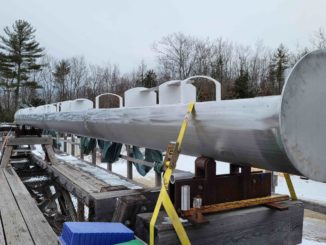
Dielectric will soon bring the high-efficiency, low windload, and reliable innovation of its broadband pylon TV antennas to FM broadcasters. Dielectric’s new FMP antennas represent the broadcast industry’s first slot cavity microstrip FM antenna product family, bringing novel benefits to high-power FM broadcasters. Benefits include multicasting, pattern flexibility, increased reliability and small tower footprint. Dielectric will publicly share full details of the FMP family for the first time at the forthcoming 2022 NAB Show (April 24-27, Las Vegas Convention Center, Booth W7107.)“Television broadcasters have long valued pylon antennas for their straightforward designs, versatility and structural benefits such as low wind load,” said Keith Pelletier, Vice President and General Manager, Dielectric. “The cylindrical design attributes of pylon antennas historically translated to narrow bandwidth characteristics that were impractical for FM signals. Dielectric’s engineering breakthroughs introduce techniques to increase that bandwidth, making full-band FM operation in pylon antennas a reality.”The engineering breakthroughs include reducing the antenna Q factor, which improves the bandwidth from one to 20 percent; and stabilizing the H:V ratio across the band. The 20 percent bandwidth translates to full FM band operation, which is the key goal of the FMP antenna’s design. Dielectric has also included its patented parasitic dipole, which adds a vertical component to the existing horizontal signal. This creates more pattern options for FM broadcasters, including elliptical and circular polarization, and contributes to the substantial bandwidth increase.While Dielectric’s special pylon designs for FM radio differ from TV systems, the FMP family carries over many traditional pylon antenna benefits including optimal downward radiation, smaller size and lower weight. For example, FMP antennas reduce the number of parts used in equivalent ring-style antennas by more than 60 percent. The streamlined componentry also improves reliability over the long term as there are far fewer parts to repair or replace.The pylon design also provides broadcasters and tower crews with top-mounting options, in addition to the traditional side-mounted configurations of ring antennas. This is ideal for high-power FM stations that want a true top-mounted omnidirectional antenna. The FMP can handle input powers of 100kW and higher, which also makes the antenna excellent for combined operation of multiple stations.Dielectric’s FMP designs use full-wavelength spacing between antenna elements. This reduces the number of antenna elements required compared to ring-style designs, which require half-wavelength spacing, hence more elements, to cover the full FM band. The efficient design is also easy to scale. Antennas are built in four-layer building blocks and can be increased to eight or 12 bays to suit higher power requirements and elevation pattern gains.Dielectric’s abilities and drive to push innovation is showcased further with the actual FMP antenna design process, which was completed in a virtual environment and then quickly built to validate the designs. This process would traditionally take years and numerous iterations of parts to develop the antenna. Dielectric recently established a team of specialized engineers to create new designs quickly and efficiently using HFSS (High Frequency Simulation Software), which greatly accelerated the development process.Dielectric, which turns 80 this year, revolutionized FM broadcasting in the 1960s with the first dual-polarized antenna, which introduced the concept of circular polarization from a single FM antenna element. The company again changed the game in the late 1970s with a quadrupole design that unveiled bandwidth improvements that remain present in modern ring-style antennas. Pelletier cites these examples as the roots of the innovations behind the FMP family, while also incorporating Dielectric’s experience in building pylon systems for TV stations.“We are always looking at ways that we can bring antenna design concepts from one market to another and advance the technology for modern and future broadcast systems,” said Pelletier. “We have now adapted what was long a solution for mostly single-channel TV operations for both broadband TV and FM broadcasting, which very much differentiates our product portfolio from competitors.” […]