ASIA

Growing digital revenue #RDE22

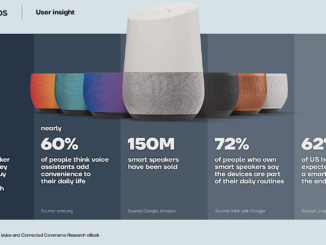
“When you start interacting with smart speakers and you find out how convenient they are, you start thinking what else can it do and how can it make my life easier,” said Paul Cranwell from AdTonos in a RadioDays Europe session about growing digital revenue.Where is voice interaction going next and how will it influence advertising on radio and other media?Smart speakers will be an important part of interaction via audio, especially in the home. A UK survey showed that 20% of smart speakers are likely to buy via the smart speaker in the next month and that 60% of voice assistant users think it adds convenience to their lives.Voice is integral to cross platform purchasing, according to Cranwell. It is also becoming more important in cars and games.“Gaming is bringing interactive audio to life in its 3 billion people eco system.” Audiences for audio ads in games can hear similar ads as they do on their streaming services now in their gaming apps. “Advertisers are realising that if you serve a video ad in a game, it stops the game, but if you serve an audio ad and the audience can keep playing the game the ad is more a part of their experience.”It’s not just nerdy young males playing games. The average gamer is 34 year old and female, they are playing games such as Sudoku on their phones on the way to or from work.There are now 1000 voice activated apps in the new Audi. “Is your radio station ready to be prominent in the car… is your radio station offering interaction through voice,” asked Cranwell.

With interactive voice functions, stations can integrate selling, donations to charities, interactive campaigns/promotions, and sponsored voice games. “Everyone loves a pub quiz, why not do one via an interactive voice interface,” he suggested.Cranwell also discussed having your own audio apps and asked, why bother with them?Here are the reasons why he thinks it is worth radio stations bothering to have their own apps:
To find first party data, to capture your own data
Better audience engagement is an extension of your brand now and people are willing to register and give you their data if you engage with them well enough. First party data is very valuable
Talk shows – are you capturing them in the podcast library part of your app, why not get advertisers to sponsor the library back-catalog
E Commerce can be integrated into your app
Programmatic ads – it’s easy money and there is a lot of money going through programmatic at the moment
It gives you the ability to interact through smart speakers for games and interactivity
Social media – live audio rooms (Clubhouse), use these new channels
Roger Cutsforth, who had a long career in radio sales before founding radio and audio consultancy White Label Studio, gave an agency view about buying digital.“When I went to pitch to customers we spent a lot of time talking about our wonderful brands but not enough time on what the prospects wanted to do… digital buying cuts through all that,” he said.He says radio networks must integrate digital revenues and make their audio ads available in the digital space. “Radio ad revenues have been challenged by the digital world… buying digital is easy. With radio the advertisers still have to talk to people and find out which station is best, then buy it… they prefer a dashboard, it makes it easy for them to buy.”If audio is to hard to buy they will just go for the digital channel. He says clients want radio stations to “make it easy for us to buy radio… At the moment, it’s too hard.”Buyers don’t know audio very well, so Cutsforth urges radio sales departments to think about what is going  on in their world and relate to them by using programmatic language and tolls. “Relate it to what they know and educate them about what audio can do. Don’t talk about numbers, instead tell them about the strengths and benefits of audio. Where do we fit in their ecosystem and why will it work?”This attitude is also holding back both radio and podcast advertising according to Cutsforth.AdTonos is a platform and marketplace for digital audio advertising. […]
ASIA

Radio needs to continue to grow and develop #RDE22

Cilla Benkö, Director General Swedish Radio, delivered the keynote address at the opening of Radiodays Europe today in Malmö.She began her address recapping the invasion of Ukraine on February 24th at 4am, bringing war to Europe.Eight minutes later, Swedish Radio cleared their talk station P1 of regular programming to broadcast non-stop for the next 48 hours covering the invasion, using correspondents on the ground and local voices giving local perspectives from local channels, as well as in-depth analysis from internal and external experts.Benkö says that during this 48 hour period, SR’s P1 gained 400,000 to 500,000 new listeners that “…didn’t come from another Swedish radio channel, they didn’t come from commercial radio either.” She urged the audience to remember that they all have “…colleagues on the ground in Ukraine covering the war, giving the public historical voices and historical perspectives and while we are sitting here in comfort they are taking a huge risk and are in huge danger.” She says that audio is now booming with rapid growth like never before and that “Never before have there been so many players investing in sound, both public service and commercial. We have ordinary radio channels on on-demand offerings such as podcasts and news clips, and audio books. “Listeners have an enormous amount to choose from.” Seeing Spotify as the biggest competitor for radio, Benkö says radio has to continue to grow and change, but that its connection to the listener remains radio’s biggest strength, but says that radio stations “…need to develop linear formats while at the same time spearheading new on-demand formats.” […]

ASIA

Radiodays Europe is officially opened #RDE22

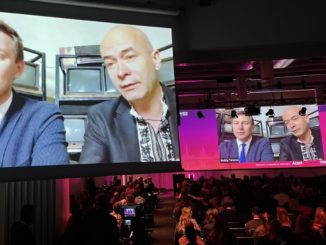
Radiodays Europe officially got underway this morning with 1200 delegates attending this year, and almost all of them in attendance for the opening where they were entertained with a performance by best-selling artist Darin.Radiodays GM, Peter Niegel, welcomed the delegates highlighting the importance of audio saying “Audio today is stronger than ever in reach and in importance, and in the past year it has again risen to the challenge through the pandemic, and especially in the past few months with this terrible conflict in the Ukraine.” Cilla Benkö, Director General of Swedish Radio, delivered the keynote address beginning with SR’s response to the Russian invasion of Ukraine that saw a huge rise in radio audience numbers as audiences sought out a trusted news service.Appearing via video link from a bomb shelter, Ukraine Public Radio’s Dmytro Khorkin and Andriy Taranov say that they have not stopped broadcasting since the start of the war despite Russian forces destroying other telecomunications networks.AM radio in Ukraine continues to be able to reach vast number of the population, even though the internet, cell phone towers and other communications services are now destroyed.“Radio is an absolutely vital medium in Ukraine at the moment,” said Andriy Tatanov from his broadcasting bunker.“In Mariopol, in Kherson, the Russians destroyed our equipment. Nevertheless, we are able to bring the essential information that our listeners are waiting for… We’re broadcasting and that’s the main thing.”Other speakers at the opening today included Christer Modig, VP Radio at Nent Group Sweden, Stefan Möller, President of the Association of European Radio and Siobhan Kenny.After lunch, a feature in the main room (there are 4 tracks in 4 different rooms, the day is packed with content) was the writing of a live song for the conference.

Every Sunday Jonas Gülstorff, together with a famous Danish musical artist, writes a song based on a listeners life on the youth station P3 from DR, Denmark. The listener decides the topic, but the challenge is, whether Jonas and his guest can actually write a song in two hours and perform it live at the end of the show.
Participants experienced the show live today.
On stage with Jonas was famous Danish musician Alexander Oscar and together in just one hour, they wrote a song about radio for one of the delegates in the room.

Gülstorff’s program, Songwriter was elected the best musical program in Europe. The program gives the listeners a unique opportunity to get even closer to their musical idols and at the same time get a song especially made for them. […]

ASIA

Designing your podcast to be a success #RDE22

Tom Webster from Edison Research presented some interesting figures to the large audience in attendance today at Radiodays Europe.According to the Share of Ear figures this year, podcasts now have 5% of all audio listening in the USA, up from 1% in 2014.During the height of the 2020 lockdown in the US, podcasting was at 6%, but as people have headed back to work this has eased.Podcasting used to be 4% of all spoken work audio consumption, but now sits at 20%.Today 13-24’s who listen to spoken word audio, are spending 35% of the time listening to podcasting, and only 16% with AM/FM radio.In a list just released in the past week the US top genres by reach are:
Comedy
News
Society & Culture
True Crime
Sports
TV & Film
Business
Arts
Religions & Spirituality
Education
Health & Fitness
History
Science
Music
Leisure
Webster told the audience that the top four of these, Comedy, News, Society & Culture and True Crime are separated from the rest of the pack by quite a distanceComedy at around 40%, News just under 30%, Society and Culture around 25% and Crime next before the rest drop away.Of the top 20 podcasts in the USA all except for 2 come from these genres.On designing a successful podcast he says it is important to know where a podcasts fit into the listeners life.Webster says that habit is particularly important, and creating habit for the prospective listener draws them in.This habit should include new episodes either daily or weekly, but consistently, and that the podcasts should be reliable, topical and always updated, as these are the shows with which people build a habit.On building a successful podcast in 2022, Webster says, “The first thing, and the most important thing for me is habit. It is incredibly important to be able to build a habit, which is certainly something that a News podcast can do. “To me it’s important to think about a a brand and a feed. An RSS feed that delivers predictable, reliable and consistent week after week if not day after day, is a thing to build a brand upon.”He says it is difficult to launch a short run series as the risk reward ratio is much steeper than doing something that runs daily or weekly.However, he says that it is possible to build a brand around a series of sequentially short run podcasts on the same topic or a similar theme that can again build habit.Familiarity is the next important value for a successful podcast, and this can be “…something that people are familiar with on the outset, whether that is a human, or a format or whether that is a concept, that’s all very important.“Other than that, the third way to succeed in 2022 is just straight up murder, true crime.” […]

ASIA

Making podcasts pay #RDE22

Daniella Murphy, creative director at Acast UK talked about how to make podcasts pay without selling out, in today’s Podcast stream at Radiodays Europe.“Ads don’t need to be a tax that poor pay to consume good content… Ads should be just as enjoyable as the content,” she told conference delegates.She also urged podcast advertisers to “take the conversation into the real world.” To illustrate the point she told the story of a bank that teamed with a podcast to create a card game called ‘Money Talks.’ Each card asked a question to get people having conversations and asking advice about money, something that people in the British target audience were reluctant to do.As part of the promotion for the game and the bank, Acast and the agency responsible got many podcasters to play the card game in their podcasts and include the conversations they had about money. The response was so strong that there was huge demand for the card game. “It took the conversation beyond audio into the real world,” said Daniella.Daniella’s Ten Commandments for good podcast advertising are:
Respect your audience – “it’s an intimate environment, don’t shit in my head,” with over the top or disrespectful messages.
Worship simplicity – “what is the single most important thing to communicate,” take away all the rest and put that in the ad.
Be believable – “the audience feel they’re your friend… friends don’t lie to you.”
Embrace emotion – “people are full of emotion” put it in your podcast ads
Stories not scripts – you will get your message across better by telling stories not making hosts read boring ad scripts.
Show don’t tell – “use immersive sounds, place people on location by letting them hear the kitchen or the factory… don’t rely entirely on words.”
Never copy and paste your creative – “tailor it to the podcast medium, which is a highly personal medium.” Don’t just use radio ads on podcasts, tailor your treatment to the podcast environment.
Beware of Cliches – “is there a more interesting way to say it than using advertising or compliance jargon.”
Think beyond the podcast to the real world
Have fun!
In the same session, Rob Greenlee from podcast hosting company Libsyn said podcast listeners are increasing everywhere and the industry is “expecting a huge increase in monetisation right across the world.”“The beginnings of podcasting were largely anti-commercial, but things have changed over the 18 years that podcasting has been around. Now people want to get a return on the investments they have made in podcasting,” he told conference delegates.He showed a chart illustrating the penetration of podcasts into major world markets as a percentage of internet users. Canada and Sweden are doing very well and  there is growth happening on most developed markets.Why should people advertise on podcasts?“To reach and target matched niche audiences,” said Greenlee. “Radio is not made in a way to take advantage of niche audiences but podcasts can. It is also a safe medium for advertisers – something their brand would like to be associated with.“Campaigns are usually longer and frequency is important, so is the value of the message and the trust between the podcaster and the audience. Advertisers get a targeted educated audience with good disposable income through podcasts.”Greenlee predicts that podcast revenue worldwide will be worth $2 billion this yearTo be successful in monetising your podcast Greenless says you should ask who is your customer, the audience or the advertiser? “What you answer will have an impact on your growth and who you are trying to reach.”“Podcasting builds strong trust and relationships with the audience and it builds advertiser trust,” he said, outlining the types of advertising in podcasts.One of the significant changes is the increase in dynamically inserted ads and the decrease of baked in ad reads that are recorded when the podcast is recorded and remain in the show forever. The new term being used is not ‘baked in’ but ‘faked in’ advertising – the host still reads updated ads, but they are dynamically inserted, even into old shows.In Greenlee’s opinion, putting the ad within the content (mid-roll) is better than putting it at the beginning of the content (pre-roll) because it connects better to the host and the content that people are closely listening to.For less commercial shows, paid podcast subscriptions and crowd funding through donation platforms such as Patreon are more successful than inserted ads, because those podcasts may not have enough listeners to gain much advertising.In a session in the same stream Julie Shapiro, Lory Martinez and Arif Noorani discussed their podcast company philosophies.Arif explained that CBC Podcasts are a mixture of repurposed radio shows and new bespoke shows.“Narrative storytelling is where we excel… We want our content to do well on the world stage.”Lory’s company takes a pragmatic approach: “We ask, will this resonate with people in other countries, other than the one it has been made in.” She used the examples of a story about a Mexican girl. “It was not a Mexican/American story, it was a story of a girl looking for her missing mother.”New podcast genres that the panel identified as likely to take off in the coming year in include:
Biographies and memoirs
Science Fiction
Comedy
Children’s audio
It is no surprise that News podcasts are so numerous in popular podcast genres. Tom Webster said that his Edison Research studies have confirmed that habit is a big factor in success.“When news podcasts are released at the same time daily you build a habit around them… predictable reliable and consistent delivery produces rewards.” […]

ASIA

How a youth station in decline reinvented itself: #RDE22

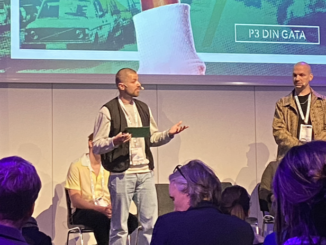
Amel Suljevic and Petter Hallén from P3 DIN GATA took the audience through the reasons their station has become so successful in the past two years since changing formats.The station was relaunched in 2020 to become a Hip Hop station, and a big part of their success lies in that they hired hosts with a love and knowledge of the genre that would broaden the appeal, making P3 DIN GATA the station Where Hip Hop Lives.Petter Hallén says that rap is now the most pop style of music in Sweden and those that follow that category has now expanded so that the younger listeners are either listening to, or at the very least aware of this genre of music.Back in to mid 2010’s it was mainly young immigrant rappers in Sweden who were performing and promoting rap to a small audience, but this scene has now expanded onto mainstream music, and P3’s entry into Hip Hop means their audience is now highly engaged.Their presenters use 3 main points to keep that engagement strong
Do not try to figure out “youth focused content”
Be really good at what you do
Be who you are
He says a young audience can spot a fraud quickly, so it is important to be real, and this usually means being true to oneself.Petter’s success, despite his age of around 40, is based around his knowledge of Hip Hop. He shares the same cultural references as his audience without trying to sound like a 17 year old.The station talent’s approach to its audience also means that artists want to be a part of the station.P3 also doesn’t necessarily report on news unless it is music/artist linked, so, for example, the recent riots in Sweden weren’t reported on the station. […]