ASIA

Are You Transactional or Relational?

Selling Radio Direct with Pat BrysonYou’ve probably heard the discussion on transactional versus relational buyers. Transactional buyers are mainly concerned with price, with acquiring what they need and getting on with their lives. Relational buyers are concerned about relationships. Price is not as important to them. They are more likely to become long-term customers.Which brings us to the discussion of how we sell to our clients. Are you a transactional or a relational seller?Let’s explore the difference.In transactional selling, the focus is on the product. It forces the buyer to make the connection between their needs and what we are selling. Often, they can’t do this because what we offer them doesn’t fit their needs exactly.Selling packages falls under transactional selling. The price is usually small, schedules are for a short time (I’ve rarely found a package longer than 3 months). As a transactional seller, you might present this way:“We have this new package out… It’s only $99, $150, $250. I thought you might like it.”“This package has the cheapest rates of the year. But you have to do it today.”“I know you want to support the team, community, etc.”“We have these Holiday greetings. It’s only $99.”Sound familiar? While I realize we do need some packages, especially if we are selling sponsorships to something, but I encounter the “package du jour” weekly. I call this “selling a ‘thing.’” The “thing” is the package. Because most transactional sellers haven’t progressed to selling a concept, they sell the “thing.”Relational sellers focus on the product needs and personal needs of their buyers. They fit their offering to those needs. They present what the client needs to buy, not what they need to sell. They tailor the campaign to the specific goals of the buyer. They understand the buyer’s needs and goals because they discovered them by doing a detailed customer needs analysis. They spend more time developing the relationship with the buyer and understanding how that client’s business works. The upfront time is longer: the payoff is bigger.Today most of us sell radio, digital, outdoor, print. Successful salespeople sell campaigns, not a few “spots”.Here’s the point: 60% of dollars involved in selling are sold in the consultant (relational) posture.What type of seller do you want to be in 2023?re You Transactional or Relational?P.S. My book, “Successful Broadcast Sales: Thriving in Change” can give you a roadmap to transitioning from a transactional seller to a relational seller. Or, you can get your managers to hire me to teach you how. […]

ASIA

OMG! Did That Just Go to Air?

Content from BPRThe recent death of Queen Elizabeth II is an important reminder of the sensitivities the media faces in dealing with such news. It’s not just the way the announcement is made and the commentary following but also, depending on the station’s format, the surrounding content.If anyone in Britain was prepared for the emotional fallout of the death of Queen Elizabeth II, it was the country’s radio announcers and producers.According to Ben Cooper, Chief Content and Music Officer at Bauer Media Audio UK at the time of the Queen’s death, blue “Obituary Lights” flashed in radio stations around the country. Long-standing protocols, known as “Obituary Plans,” quickly kicked into gear. There would be no more advertisements. No on-air competitions. Prepared playlists flooded the airwaves.As the country was still processing the death, British radio had already turned down the dial on the fun and begun providing listeners with more sombre sounds: Coldplay’s The Scientist, for example, Simon and Garfunkel’s Bridge Over Troubled Water, The Cars’ Drive and a lot of Adele, according to Cooper.At least they were well prepared. However, there have been many occasions where radio stations have failed to put systems in place to prevent insensitive content going to air.Recently in Australia, a leading and popular sporting identity committed suicide. He was loved by sporting fans, players and the media.Naturally, radio presenters in his home town were discussing the tragedy on air.So picture this. The presenters, some of whom were his friends, on one station (a Talk station) were discussing the topic interspersed with music (a recent addition to the Talk station). However, no one bothered to check the logs to see if the songs were appropriate for the topic.The songs played during the discussions included Gloria Gaynor’s “I Will Survive”, Australian Crawl’s “Downhearted” and Queen’s “Don’t Stop Me Now”.To give the presenters credit, they didn’t refer to the songs in any shape or form. But surely someone at a programming level should have made the call to check the logs to ensure that every song would fit with what was one of the day’s big topics. Or even drop the songs entirely……as mentioned, music is a new addition to the format.It’s like the time an announcer was doing an Outside Broadcast to raise funds for bushfire victims. The bushfires were some of the worst in that country’s history. The announcer was doing the live top of hour over a song intro per usual. A good, heartfelt top of hour….only trouble is the song was Billy Joel’s “We Didn’t Start The Fire”. Many other stations during this time put songs that mentioned fire, burning etc on hold…..”I’m on Fire”, “Burning Down the House” and the aforementioned Billy Joel song.Then there’s the other side of the coin where quick thinking by an announcer stopped an inappropriate song going to air. As mentioned above, most UK radio stations have an “Obituary Plan”, which is a plan of what to do in the unexpected death of someone prominent. It includes a list of “appropriate music” to play. The announcer in question was solo, presenting a networked show in the early hours of Sunday 31st August 1997, when the “Obituary” alarm was triggered around 4:30 am in response to the death of Diana, Princess of Wales. The announcer opened the Obituary folder to find out what “appropriate” music to play, and the first track suggested was “Drive” by The Cars! As he ran down the list, almost every song had some sort of inappropriate reference to driving, accidents, broken hearts. With about 90 seconds to spare before making the official announcement and then playing the first song, he decided “Candle in the Wind” by Elton John was the least-worst choice given the circumstances.A good call!We all know mistakes happen. But preventable mistakes such as those above should not.Check the logs…….. and know the lyrics to the songs.Events like these don’t happen often. However, a misplaced song can damage your station’s reputation across all media platforms.By David Kidd, BPR […]

ASIA

Taliban releases former radio station owner after four months’ detention

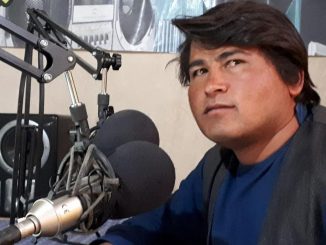
According to a report by the Afghanistan Journalist Center (AFJC), the Taliban Directorate of Intelligence prison has released Mirza Hasani, former owner and editor of Radio Aftab, a local radio station in Daikundi province of central Afghanistan, after four months of detention.Hasan was arrested at a checkpoint in Herat city while trying to move to Iran for a safer life on May 24, when the agents of the General Directorate of Intelligence (GDI) searched his phone. After seeing journalistic posts on his social media accounts, they suspected him of working as a reporter for the National Resistance Front (NRF) and transferred him to the intelligence agency’s prison in Kabul.He was released on Sunday afternoon, his wife Sakina Rahimi confirmed to AFJC via a messaging app.AFJC said: “We welcome the release of journalist Mirza Hasani, but we stress that he should never have been detained in the first place. If authorities had any grievances or found the reports biased, they could pursue the issue via the Media Complaints Commission, not by illegally detaining the reporters.”AFJC also called upon authorities to “release Journalist Khalid Qadiri who was sentenced to one year in prison in May for allegedly spreading anti-Islamic Emirate propaganda and committing espionage for foreign media outlets, and urge them to ensure journalists can do their work without interference, fear, or reprisal.”Based on the AFJC’s finding there have been a total of 245 cases of violations against media freedom in Afghanistan, including 130 cases of short-term detention of journalists during one year of Taliban rule.These detentions, which lasted from one hour to several hours and even some months often included physical violence, insults, and even torture of journalists.Photo: AFJC […]

ASIA

Spoon radio records nine consecutive months of growth

Korean startup Spoon Radio Inc has shared its business results for the first three quarters of the year, registering a profit for nine consecutive months from January to September.The company earned 34 billion KRW ($23 million) in gross revenue and had an increase in operating profit of more than 23 billion won ($16 million) compared to 2021.Spoon is a social digital audio live streaming service which allows users to listen to streamers and even start their own live streams using their smartphones and web, without any other equipment. It provides services in four languages, including South Korea, the United States, Japan, and Middle Eastern and North African regions. It has an average of 1 million monthly users as of September 2022.Its growth has been helped by a steady increase in monthly in-app purchases and a rise in the number of high-income DJs in Japan.The company recently shifted its strategy from that of aggressive marketing until last year to strengthening profitability this year.The main driver of its earnings growth this time is securing high-income DJs. Compared to last year, the number of high-income DJs increased by more than 20 percent, from 840 to 1,030.In addition, it has focused on countries with high potential through selection and concentration in the global market. As a result, about half of the current total users are Japanese users. The payment amount in Japan is also increasing steadily enough to account for more than 50% of the total payment amount.Choi Hyuk-jae, CEO of Spoon Radio, said: “This achievement is meaningful in that it proved that it could break away from the so-called deficit growth strategy of the past, which prioritized aggressive marketing costs and created operating profit. We plan to focus on growing together, improving the quality of content, and growing sales.” […]

ASIA

Join the Conversation: The Incredible NOW! Radio Success Story – Part II

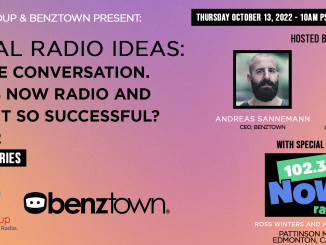
Benztown and P1 Media Group will host a free webinar on Thursday, October 13, 2022, for radio professionals around the globe, entitled Join the Conversation: The Incredible NOW! Radio Success Story – Part II. The webinar will be hosted by Andreas Sannemann, CEO, Benztown, and Ken Benson, Partner, P1 Media Group, and features Mark Hunter, VP of Programming, NOW! Radio, and Ross Winters (pictured), Director of Programming, Pattison Media, Canada’s largest western-based media company. This is the 25th in the webinar series from top radio experts from around the world.Mark Hunter started his radio career in 1985, when he was hired on his 19th birthday to work with Rawlco in Saskatchewan, in Saskatoon, Prince Albert and Regina.He was on-air, producer, creative director, and News/Talk producer before he got his dream job as Program Director in 2000.In 2009, Hunter was named Program Director of a new license in Edmonton, CKNO-FM, and eight months later, NOW! Radio was born. He programmed 102.3 NOW! Radio Edmonton for 10 years, driving huge ratings and billings success which continues today.Hunter is currently a Senior Programmer for Pattison Media, working mostly in Metro markets including Calgary, Winnipeg, and British Columbia.Ross Winters began his radio career as a DJ at a Top 40 radio station in Victoria, British Columbia. He quickly moved into programming and worked as Program Director at legendary Canadian Rock stations in Winnipeg, Vancouver, and Toronto.While programming Rock 101 in Vancouver, Winters also served as National PD for Corus Entertainment, one of the largest groups in Canada. He spent time as a researcher and consultant before joining Pattison Media as Director of Programming in 2015.In the 30-minute webinar, Hunter and Winters will continue the conversation with their unique take on programming successful radio stations today, and the power of doing things differently, including:
How a truly different type of radio station became a runaway success and what do they do differently than other radio stations?
NOW! Radio’s slogan is “Join the Conversation.” Are there any topics or conversations that are off-limits?
As a result of NOW! Radio’s long-term success, more Canadian music stations have increased the personality quotient. Is this a good thing for radio and what should Music Radio programmers know before increasing the personality quotient on their stations?
How has creative outdoor advertising worked to drive the success of NOW! Radio and what are some of their most successful campaigns?
Does this format only work in a Hot AC format, or could it be put in a completely different format?
The webinar will take place this Thursday, October 13, 2022, at 10:00am PST/1:00pm EST/7:00pm CET. […]

ASIA

Changing Car Audio Technology

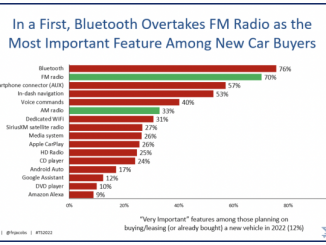
Content from BPRUS auto makers are ceasing production of car audio systems that include the AM medium-wave band. European car makers have been doing so for years.So why are US auto makers deleting AM medium-wave band from car audio systems? The reason may not be so obvious.In the US, almost all AM stations have reverted to news/talk programs as car listeners have come to realize that the audio quality of AM medium-wave is clearly inferior to that of FM and digital audio. However, an additional reason for the abandonment of AM stems from the fact that electric vehicles (EV’s) produce electromagnetic waves at around the same frequency as AM medium-wave signals. The result is significant interference between the AM receiver and the EV’s engine.It is ironic that the advent of electric vehicles will be the final straw that breaks the back of AM radio listening in the US.Electric vehicles are here to stay. EU member nations have agreed to stop sales of internal combustion autos by 2035. The large US auto makers will probably not be far behind as internal combustion engines go the way of tyrannosaurus rex.The Jacobs Media Tech Survey 2022 that was conducted in the US shows that Bluetooth has now overtaken FM as the preferred audio source in automobiles. The reason is fairly obvious. An increasing number of car listeners use their mobile phones as a primary audio source and Bluetooth is currently one of the most common methods of connecting a smart phone to a car audio system. We can safely conclude that the smart phone is for many users the primary source of audio content in the car.As this trend progresses, radio stations are finding themselves directly competing with virtually every other digital audio source available on a smart phone.Even FM radio has become harder to find in modern car audio systems. FM is just one of a number of listening choices on the car touch screen.Once again, we are reminded that radio companies are essentially audio content providers. Our job is to ensure that our program content is appealing and unique. In the age of digital audio, all players are equal. It is only the content that distinguishes the winners from the losers.By Andy Beaubien, BPR […]