
ASIA

RTI and AIB co-host Taiwan focused-forum

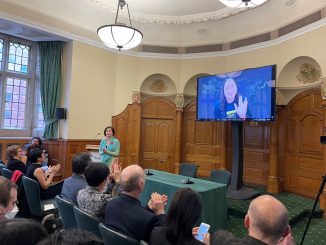
Radio Taiwan International (RTI) and the Association for International Broadcasting (AIB) came together to organize a forum on Taiwan in London on Friday.Taiwan’s President Tsai Ing-wen opened the Forum with a pre-recorded speech.She said the spread of authoritarianism, false information, and the suppression of media freedom have placed an unprecedented burden on journalists. Tsai said the AIB nominations reflect the many challenges facing the world today, from the COVID-19 pandemic to the Ukraine War. The president said everyone must work together to defend press freedom and make society more resilient to authoritarian influence.

Tsai said that Taiwan has established a new Ministry of Digital Affairs to further enhance media literacy and improve national information security. She is pleased to see government measures to strengthen transparency, fact-checking, and media participation bringing tangible help to the public. The president said she is glad to see discussions of topics related to Taiwan being held at the AIB event.Tsai noted that Taiwan has a vibrant media environment and is rated by Reporters Without Borders as one of the freest countries in Asia.  She said she hopes to see more and more international media stationed in Taiwan.Digital Minister Audrey Tang also spoke at the event. Tang shared Taiwan’s experience facing online attacks and countering disinformation with humorous content. She said Taiwan is a resilient island and the country has many ways to respond to different kinds of attacks. Her ministry’s purpose is to enhance digital resilience and to protect Taiwan’s democracy.Taiwan Digital Diplomacy Association head Chiayo Kuo said her organization uses memes and other soft power methods to improve Taiwan’s image in the world. She said the war in Ukraine has demonstrated the importance of the internet in modern conflicts. She hoped that digital diplomacy efforts like those from her organization will bring more people to Taiwan’s side.RTI Chairperson Cheryl Lai said Taiwan’s national broadcaster is combining the strength of the government and civil society to lead Taiwan’s participation in international events. […]


ASIA

Indian government appoints new Prasar Bharati CEO

India’s Ministry of Information and Broadcasting said that senior IAS officer Gaurav Dwivedi  has been appointed the Chief Executive Officer (CEO) of public broadcaster Prasar Bharati on Monday.Prasar Bharati is India’s state-owned public broadcaster, headquartered in New Delhi. It is a statutory autonomous body set up by an Act of Parliament and comprises the Doordarshan Television Network and All India Radio, which were earlier media units of the Ministry of Information and Broadcasting.The I&B ministry in a statement said: “In exercise of the powers conferred by sub-section (1) of Section 4 of the Prasar Bharati (Broadcasting Corporation of India) Act, 1990 read with sub- section (4) of Section 4 and sub-section (2A) of Section 6 of that Act, the President, on the recommendation of the Selection Committee, is pleased to appoint Shri Gaurav Dwivedi, IAS(CH: 95) as the executive member (chief executive officer} in Prasar Bharati with effect from the date he assumes charge of the office, for a term of five years.”

Dwivedi is currently posted as chief executive officer of MyGov, under the ministry of electronics and information technology and is responsible for managing the Indian government’s citizen engagement platform.He replaces Shashi Shekhar Vempati. Shashi Shekhar Vempati was the CEO of Prasar Bharati from 2017 to 2022. After Vempati completed his five-year tenure, Director General of Doordarshan Mayank Agrawal was given the additional charge of CEO Prasar Bharati in June this year. […]

ASIA

Australia’s SBS adds more Indian language news bulletins

Australian public broadcaster SBS has expanded its international news offering, adding news bulletins in the major South Asian languages Malayalam and Gujarati.The news bulletins from India’s public broadcaster Prasar Bharati are being shown on its SBS WorldWatch channel.SBS WorldWatch launched in May 2022 as a free-to-air channel, expanding the broadcaster’s international and multilingual news offering. The channel provides Australians with access to news bulletins from around the world in languages other than English.

The two bulletins have been added to better serve Australia’s evolving news audiences, as speakers of Gujarati have increased by 54 percent since the 2016 Australian census and speakers of Malayalam by 48 percent.Central to the channel’s offering are SBS’s flagship half-hour nightly news bulletins in Mandarin and Arabic, produced in-house, serving the two largest non-English language audiences in the country.Director of News and Current Affairs, Mandi Wicks, said: “With the launch of SBS WorldWatch, the SBS network has undergone broader rescheduling of our multilingual TV news across the network, now offering 66 news bulletins from 49 different broadcasters in 36 languages other than English, and 20 in English.”SBS WorldWatch builds on SBS’s commitment to provide comprehensive news and information across its network – in English through SBS World News and in more than 60 languages across SBS Radio services, podcasting and digital platforms.(Photo: SBS) […]

ASIA

India’s private FM players urge TRAI to Keep not-for-profit firms out of community radio space

India’s private radio players, through industry body Association of Radio Operators for India (AROI), have urged the country’s telecom regulator -Telecom Regulatory Authority of India (TRAI), not to recommend allowing not-for-profit companies to run community radios.According to them, granting permission to not-for-profit companies falling under Section 8 of Companies Act, 2013, would come at a financial loss to the exchequer as such companies would become eligible for benefits like reduced license fee, access to spectrum without auction, lower spectrum usage charges, among others, thereby reducing revenue for the government and giving strong competition to small community radios.Presently there are 356 community radio stations operational in the country, broadcasting content that is of specific interest to communities in a particular geography. Current rules permit only civil society and voluntary organisations, educational institutes, state agriculture universities, registered societies and autonomous bodies, and public charitable trusts are to operate community radio stations.

In July, following a suggestion from the Ministry of Information and Broadcasting, TRAI had sought comments from stakeholders on whether not-for-profit companies under Section 8 should be allowed to set up community radio stations.Section 8 of the Companies Act includes companies formed to promote commerce, art, science, sports, education, research, social welfare, religion, charity, protection of environment or any such other object. Such companies also intend to apply their profits or other income to promote their objectives.“Section 8 companies are set up by large organisations, and through community radio stations they will get a back door entry to commercial radio broadcasts at negligible costs,” said Uday Chawla, Secretary General, AROI, during an open-house discussion conducted by Trai on the subject.“If I am running a larger organisation, I will be able to create an NGO and take a community radio licence … then why is there a need for auction of spectrum by the government,” he said.“Basic purpose for community radios is to cater to people in a particular geography. However, Section 8 companies are thematic and incorporated for special purposes, therefore, they may not be able to serve specific interest of a community and should not be allowed,” said Prashant Ramdas, legal head at Entertainment Network (India), operator of Mirchi FM.While certain levies for community radios are kept at a bare minimum, the industry has been struggling for a sustainable business model due to fewer advertisements and limited access.“Community radio as an industry is struggling. We want the government to provide us financial support,” said B S Panwar, president, Community Radio Association of India. The association, along with community radio station operators, has urged the Centre to provide them annual grants and ask state governments to use community radios as a preferred medium to advertise their policies. […]

ASIA

You Can Do Anything, But Not Everything – David Allen

Content from BPR.Every day consumers face a barrage of messages, from information to commercials to conversations.Messages can be visual, audible or both – but we have adapted to the increase in environmental noise by simply filtering out messages that we don’t regard as important.

When new messages or information don’t conform to our assumptions or meet our needs they are rejected or ignored. Existing brands that have established clear impressions can only evolve within an established set of ‘guidelines’, ones that consumers see as consistent with their brand expectations.Positioning your Brand:Brand positioning is a result of a clear focus, consumers understand (and like) what they get, inconsistent or unfocussed content or marketing dilutes these clear ideas, clear positioning also generates brand loyalty.Before you can ask for loyalty from customers, you have to know exactly what it is you are offering them, and how you will consistently offer them that experience each time they choose your product or service. Apple is one of the most recognisable brands in the world, with a customer base that is extraordinarily loyal. Regardless of what it is — iPhone, iPad, Apple Music.Renew or evolve:Over time customer needs develop and evolve – does your brand evolve with them or do you constantly need to bring new customers? This is a major issue for radio, especially those stations aimed at GenZ listeners as a recent Guardian Australia article on some of the difficulties facing Australia’s Triple J network in connecting with its core 18-24 audience.“Most people just find [new music] through the algorithm, It’s right there on our phones giving us recommendations constantly, and there’s no news or banter in between songs.” Unlike those platforms, Triple J can’t possibly be everybody’s everything.The one constant in all of this is that successful brands stay in touch with the changing needs and priorities through audience feedback and market research. For radio, the quest for younger listeners becomes more difficult with the explosion of alternatives including lifestyle, social and music options.In the US, radio is well behind in reaching younger age groups, as noted by prominent US consultant Fred Jacobs.“..The teen (and pre-teen) demographic has become of paramount importance across industry groups and categories.  It is a hot topic, driven largely by Gen Z’s heft and ability to set trends already affecting all of us.  In virtually every business sector, research is being conducted to better understand this generation, their mindset, and their marketing preferences.Except in radio..”These lessons are as applicable to the need to understand the changing needs of younger consumers as they are in maintaining focus on the listeners you already have.By Peter Don, BPR […]

ASIA

Veteran Singapore DJ retires after 51 years of broadcasting

Brian Richmond, a veteran of Singapore Radio, retired after 51 years on air.Richmond, 75, made the announcement on his morning show on GOLD 905, The Vintage Showcase.He began in radio in the 1970s, and has remained a steady presence on the airwaves ever since. He was given a lifetime achievement award at the Singapore Radio Awards in 2005.

“It has been a long journey – 51 years, if you please. But, like they say, all good things must come to an end. The time to make my exit has arrived, and I’ve got so much to be grateful for,” said Richmond.He added, “It’s a painful decision for me, but I’m bowing out while I’m ahead.”“I’m not going on vacation. I’m going on a long, long journey. The heady days have all gone by.”GOLD 905 thanked him for his contributions and wished him well on a Facebook post. […]