ASIA

Meeting future digital challenges goes better with face-to-face conversation: Javad Mottaghi #DBS2023

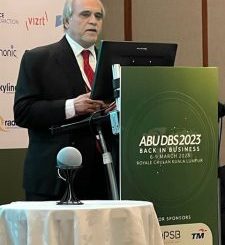
Asia-Pacific Broadcasting Union’s Digital Broadcasting Symposium returned as an in-person event after a two-year pandemic induced hiatus, and the who’s who of the digital world agreed there was nothing like face-to-face networking.“Nothing can actually take the place of a good face-to-face conversation,” said ABU Secretary General Dr Javad Mottaghi, in his opening address to the 2023 Digital Broadcasting Symposium in Kuala Lumpur.Dr Javad Mottaghi, Secretary-General Asia Pacific Broadcasting Union

“There have been many lessons learned from the pandemic, and the whole broadcast media has gone through an evolutionary change.”“It is imperative that we, especially public service media explore these changes and adopt a more digital and social centric approach taking advantage of the convergence of technologies and reposition themselves to match current industry trends and audience demand.”Evidenced by the theme “Back in Business” and from the buzz around #DBS2023, it was clear even those who provide digital solutions were happy to be have a physical presence at ABU’s premier symposium which covers radio, television and OTT streaming services with a major focus on new broadcast technologies.The overarching theme of #DBS2023 was a focus on sustainability and serving diverse community needs.In his official opening comments Malaysia’s Minister of Communication and Digital, YB Ahmad Fahmi Bin Mohamed Fadzil, echoed the importance of broadcast media and new technologies in the rapidly shifting digital landscape.“It is about helping the public come to terms, whether its with catastrophe, disaster, epidemics, pandemics, crises; but also to shed a light and provide a space for what we need more than ever before – moral leadership.”“Media and public broadcasters play a more than disproportionate role because it is the go to choice, especially when it comes to free to air, for the general public.”The Minister said that one of the biggest challenges for the broadcast media, especially coming out of the pandemic, was to ensure “that those who appears to have been left behind, not in the least in terms of the economy, of education, are not disadvantaged.”“Many media organisations may face evisceration because of the need for advertising revenue.”“It is my responsibility to ensure that we have a vibrant free press so the ecosystem is preserved, not cannibalised beyond recognition, for the greater good.”The opening session, focused on industry development and standards updates, was led by Emily Dubs, Head of Technology, DVB Project.She outlined the future challenges of developing a converged media delivery ecosystem using IP centric solutions in Malaysia and ASEAN countries.“We need to tackle that migration to IP based platforms to build converged 5G/IP/broadcast ecosystems,” she said. “DVB-I will be a crucial addition to enable the convergence of networks.”“There is a new wave of opportunities to offer alternatives to congested networks as we move from unicast to multicast, alongside potential complementarity with 5G in the future.”“New business models have potential for huge changes in transport, remote education, health care and tele-medical.”ATSC President Madeleine NolandMadeleine Noland, President of the ATSC, followed with an update of ATSC 3.0, which is the next generation terrestrial broadcast system adopted in the US, and has already been launched in projects across India, Jamaica and Brazil.Addressing the issue of congestion, she said: “We need to have an orchestration layer that allows data to flow; its about getting any data to any device.”Not only is the plan to deliver enhance audio, interactive content and advanced emergency messaging, ATSC are also working on distance learning and automotive applications”Broadcasting has a key role in a data hungry world. HPHT is really, really valuable in broadcasting as it fills up holes in networks of networks.”“It’s an opportunity to make a difference to sustainability by using infrastructure that we already have; we need to understand just how valuable the high tower is.”Lindsay Cornell, Principal Systems Architect at BBC Digital delivered an update on DAB+, saying for broadcasters this technology offers multiple opportunities to innovate, allowing more operators to be present in the same spectrum.“By running the same content through all the outlets, revenue increased far more than operation costs.”“Opportunities aren’t all about increasing revenue; DAB is the most energy efficient of all the means of delivering digital content.” […]

ASIA

Radio Pakistan Peshawar celebrates 88th anniversary

Radio Pakistan Peshawar, which was established on March 6, 1935, celebrated its 88th anniversary on Monday with a function.Radio Pakistan Peshawar  started broadcasting from a room at the secretariat after educationist Abdul Qayyum Khan requested radio’s inventor Guglielmo Marconi to establish a small radio transmitter at Peshawar. Marconi also donated a few radio sets for the station that were later distributed among people.The station has the distinction of announcing the independence of Pakistan at midnight on August 13-14, 1947 by eminent broadcasters Aftab Ahmad in Urdu and Abdullah Jan Magmom in Pashto languages.

The function to celebrate its anniversary was attended by Chief Minister’s special assistant for revenue, Syed Haroon Shah as the chief guest, Station Director of Radio Pakistan Peshawar, Syeda Iffat Jabbar, former chairman International Relations Department, University of Peshawar, Dr Adnan Sarwar Khan, senior broadcaster and academician Dr Abaseen Yousafzai, serving and retired officers, artists, musicians and poets.In her welcome address, Jabbar, who is the first female station director and controller of Radio Pakistan Peshawar said it’s a unique station from where eminent poets and writers including Ahmad Faraz, Ahmad Nadeem Qasmi, Khatir Ghaznavi, Abbasi Yousafzai, renowned Pashto singers and musicians, Khyal Muhammad, Mashooq Sultan, Ahmad Khan, Shakeela Naz, Hidyatullah, Sardar Ali Takkar, Rafiq Shinwari, drama, film and stage artists, Agha Talash, Firdaus Jamal and others have started their professional careers.Through its famous ‘Hindara’ program, it effectively highlighted Pakistan’s principled stand before the world after migration of millions of Afghan refugees following the USSR invasion of Afghanistan.Radio Pakistan Peshawar has recently signed a memorandum of understanding with Shaheed Benazir Bhutto University under which the former would provide technical support to the university for students’ education while the latter would use the platform of the national broadcaster for people and female education through its programmes.Program Manager Abdul Majeed Baloch read out the message of Radio Pakistan’s Director General Tahir Hassan,  saying that all the required facilities would be provided to this station to bring more improvement in programmes in the wake of the era of digitalization. […]

ASIA

It’s not about the budget, it’s about the schedule.

Selling Radio Direct with Pat BrysonUs: “What’s your budget?”Client: “I don’t really have one.”

OrUs: “What’s your budget?”Client: “I have $200 a month.”I bet you’ve had conversations with prospects that sounded like these. Clients often don’t want to tell us their budgets because they think we will take every last dollar they mention. Even more common than this are clients that don’t have a clue as to what they SHOULD invest in radio. They know what they HAVE spent in the past (do you run into clients who spent a whopping $99 a month?) and they have no idea that what they purchased was a waste of money. Worse yet, WE sold it to them. It’s hard to go back and change expectations without calling their baby ugly.IT’S NOT ABOUT THE BUDGET; IT’S ABOUT THE SCHEDULE.There are basically two types of advertising schedules: events and sales or branding (bonding) campaigns. The formula for creating schedules for these two types of objectives are constant across market size, format, country.Event or sale: One commercial an hour, starting at the event and working backwards 7-14 days as the budget allows. The goal is to reach as many listeners as possible in a short period of time with a message that has a “fuse” on it. The message must answer, “Why should I change my routine and attend this sale or event? What’s in it for me?” And, the message better be compelling!Branding or bonding: Enough commercials weekly to reach half your station’s audience a minimum of three times. You can figure the number of commercials it takes if you subscribe to ratings. But if not, a good rule of thumb is 3 commercials a day, 7 days a week, for at least 52 weeks. In today’s crowded advertising environment, I am now suggesting 4 or 5 a day. Many of my clients sell 2 and 3 year agreements instead of 1 year. There is a scientific reason for doing so. And remember, most businesspeople are used to multi-year leases on everything from their space to office equipment. Why not their advertising? How long people listen to your station (your TSL) is a determining factor to the number of commercials you need weekly.Although the formulas are constant across markets, formats and countries, the investment is not. The amount these schedules require as an investment will be different in Chicago, Calgary, CA, Brisbane, AU, Malta, Taylorville, Il. Figure for each of your stations what the investment should be using your rate card for each type of schedule. Now you know what budget your clients need to buy effective schedules with you.Instead of asking, “What’s your budget?”, you can use “Brackets” and 3rd party references to establish the dollars needed.“Mr. Prospect, other clients who have similar objectives to yours have found investing between $___________ and $___________ a week to be effective. In that range, where are you comfortable?You want to introduce a “high” and a “low” number that is slightly above what you need to fund the campaign. Then, you can adjust the numbers downward until they are comfortable.You have introduced the amount. This conversation is held later in the needs analysis meeting. You have determined their pains, goals and objectives. You have an idea of how much they need to invest to be effective. By using the 3rd party reference, you have legitimized your numbers.Believe it or not, we are more concerned about budgets than our clients are. We are afraid to ask for more. If the client feels we can help them to remove their pain, to help them to achieve their goals, they will find the money. Remember, they are spending it somewhere, just not always with us.As we move into selling digital products as well as radio commercials, it becomes even more important that we become comfortable asking for larger dollars. We KNOW what it takes to craft effective campaigns for our clients. We also know what probably won’t work. When using the brackets, if your client firmly states an amount you KNOW will not be enough to fund an effective schedule, you should tell them. This is where sales managers faint or try to cover my mouth with tape. Do we walk away or take an ineffective schedule? Guess which one I recommend? We do not want to create an environment in which we hear, “My advertising didn’t work.” And by standing your ground, many times the prospect will take our recommendation. After all, why type of salesperson walks away from money? Successful ones. Ones who have the courage of their convictions. Clients appreciate that. They appreciate it even more when the advertising makes them money!Concentrate on the needs and goals. Translate those needs and goals into effective schedules.Sell schedules not budgets! […]

ASIA

WorldDAB at ABU DBS, Malaysia

WorldDAB – the global industry forum for DAB digital radio – is bringing together experts from around the world for a workshop at the Asia-Pacific Broadcasting Union’s Digital Broadcasting Symposium (ABU DBS) in Malaysia.The Symposium is back as an in-person event after a break of two years and takes place from 6-9 March at The Royale Chulan Hotel in Kuala Lumpur’s downtown business district. It includes a conference, exhibition, masterclasses, and workshops, and attracts close to 1,500 participants annually, representing over 350 organisations across the region and beyond. WorldDAB is exhibiting throughout the event on stands 17 and 18, with members GatesAir and Paneda joining the pavilion.“We’re delighted to be back in person at ABU DBS,” said Bernie O’Neill, WorldDAB Project Director. “We know there’s growing interest in DAB digital radio from across the region, with popular services already well-established in Australia, and DAB+ trials in Thailand and Vietnam. Alongside this, DAB is also building momentum in the Middle East and Africa. We’re looking forward to sharing knowledge and experience at this significant event.”

On the afternoon of Monday, March 6, WorldDAB will be holding a workshop entitled “Economics, Environment, Emergency – driving the case for DAB+”. In the session, experts from around the world will explore how broadcast radio is free to air, universal and reliable in emergencies. DAB+ plays a key role in protecting those benefits, offering lower costs of distribution than FM, lower energy requirements, and greater resilience in emergencies, especially out of home.The session will be moderated by Dr Les Sabel, Chair of WorldDAB’s APAC Technical Group. The group gives guidance on the technical aspects of implementing DAB+ digital radio, with help and advice tailored specifically to the needs of the region. Dr Sabel has over 30 years of experience in communications systems.Monday’s workshop will open with a review of new deployments and opportunities for growth around the world from Bernie O’Neill. Bernie joined WorldDAB in 2011 and leads the WorldDAB project team in delivering information and advice on all aspects of deploying DAB digital radio.An update on the upgrades and advances to the DAB+ family of standards in line with recent technical developments within the radio industry will be provided by Lindsay Cornell, Principal Systems Architect at BBC Digital, and WorldDAB Technical Committee Chair. Lindsay has worked for the BBC in a variety of engineering, editorial and leadership roles spanning radio, TV, and spectrum regulation.Les Sabel will offer an overview of current deployments and activities within the APAC region and will also explore the fast-growing ‘small-scale’ DAB sector. Following this, Nick Piggott, Project Manager of Bristol Digital Radio, which operates small-scale multiplexes in the west of England, will discuss a not-for-profit model allowing community and student radio stations to broadcast on digital radio. Nick has spent most of his career working in the radio industry, initially in programming and then moving to digital radio and online innovation. He is one of the founders of RadioDNS Hybrid Radio, the open technology project that allows broadcast radio and IP to work together, combining the power of broadcasting to reach many people and the power of the internet to deliver enhanced or personalised content.Lars-Peder Lundgren, CEO of Paneda Sweden, will cover emergency warnings on DAB+. Lars-Peder has been involved in DAB from the beginning, with 25 years in the digital radio business. He joined Paneda as Sales Director in 2014 and has been CEO since 2020.Transmission solutions to manage cost will be explored by Oscar Hu, Regional Sales Manager, Southeast Asia, GatesAir. Hu’s background of almost 20 years in the over-the-air broadcast industry, where he has been active in most of the advanced DVB and ATSC digital transmission standards development.Finally, Hermann Zensen, Head of Sales and Marketing at Digidia, will discuss DAB+ multiplexing from local to national implementations. Hermann joined Digidia in 2008 as Sales Manager and has been Head of Sales and Marketing since Nautel purchased the company in 2021.As well as the Monday afternoon workshop, WorldDAB’s team of experts will be contributing to several sessions throughout the Symposium.ABU DBS will also see WorldDAB highlighting its new book: “Establishing DAB+ Digital Broadcast Radio“. The free ebook, available from the WorldDAB website, offers a unique, in-depth guide to the regulatory, technical, and commercial aspects of establishing a successful DAB digital radio service. The book provides guidance to new countries seeking to launch DAB services, as well as offering advice for markets which have already started the process, and those who are nearing permanent service status. […]

ASIA

Futuri launches world’s first AI-driven radio

Futuri has launched RadioGPT™ — the world’s first AI-driven localized radio content solution. RadioGPT™ combines the power of GPT-3 technology with Futuri’s AI-driven targeted story discovery and social content system, TopicPulse, as well as AI voice tech to provide a localized radio experience for any market, any format.RadioGPT™ uses TopicPulse technology, which scans Facebook, Twitter, Instagram, and 250k+ other sources of news and information, to identify which topics are trending in a local market. Then, using GPT-3 technology, RadioGPT™ creates a script for on-air use, and AI voices turn that script into compelling audio.Stations can select from a variety of AI voices for single-, duo-, or trio-hosted shows, or train the AI with their existing personalities’ voices. Programming is available for individual dayparts, or Futuri’s RadioGPT™ can power the entire station. RadioGPT™ is available for all formats in a white-labeled fashion.

RadioGPT™ also generates social posts, blogs, and other content for digital platforms related to the content on the air in real-time. A TopicPulse Instant Video add-on creates AI-driven short videos on hot topics for social use. By adding on Futuri’s POST AI-enabled podcasting system, stations can take broadcast audio and immediately publish it on-demand with POST’s auto-publishing feature.“As early AI innovators in the broadcast space, it’s only natural that we’re bringing the incredible power of GPT-3 technology, paired with groundbreaking technology like TopicPulse, to radio,” said Futuri CEO Daniel Anstandig. “The ability for broadcasters to use RadioGPT™ to localize their on-air content in a turnkey fashion opens up resources for them to deepen their important home-field advantages in new and unique ways. With RadioGPT™, the possibilities are endless. With RadioGPT™, there should never be a ‘liner card’ or ‘sweeper-only’ air shift again. Now everyone can be live and local.”Beta partners for Futuri’s RadioGPT™ include Alpha Media in the United States and Rogers Sports & Media in Canada.“At Alpha Media, we always seek innovative ways to engage our audiences. That’s why we’re a part of Futuri’s RadioGPT™ beta group,” said Alpha Media Executive Vice President of Content Phil Becker. “With RadioGPT™’s cutting-edge language and content technologies, we can deliver a real-time, hyper-localized, innovative audio experience. In fact, I have such faith in AI that I had it write this quote for me.”For more information on RadioGPT™, or to inquire about joining the beta launch, visit RadioGPT.ai. […]

ASIA

More speakers announced for Radiodays Europe 2023

Radiodays Europe 2023 has announced more speakers for their event in Prague this year.The latest roundup of speakers include:·       Bauer Media Group’s President of Audio, Richard Dawkins

·       Grace Zakka, Senior Project Manager at the European Broadcasting Union·       Daryl Battaglia, SVP, Measurement Products and Strategy, Triton Digital·       Steve Van Audenaerde, Director of Audio Business & On Demand at DPG Media’s sales house·       Barbora Šichanová, Editor In Chief of Czech Radio – Radio Wave·       Czech Radio’s Adam Javurek·       Renowned Music Programmer Lea Stonhill from the UK·       Marianne Bouchart, Founder and Director of HEI-DA·       Sean Ross·       Olle Zachrison, News Commissioner at Swedish Radio (SR)·       RadioAnalyzer CEO Mikkel B. Ottesen·       Kim Ohlsson, Development Producer at Swedish Radio’s new department for editorial developmentRadiodays Europe will be held on 26-28 March 2023, Prague, Czech Republic.The conference this year starts at 9.00am on Sunday 26th March with the Free Radidoays Europe Inclusive (formerly Radiodays Europe Women), event followed by three Summits on the Sunday afternoon: Youth, Podcast and Data Research (75EUR + VAT). […]