ASIA

StreamGuys empowers video and audio workflow conversions at 2023 NAB Show

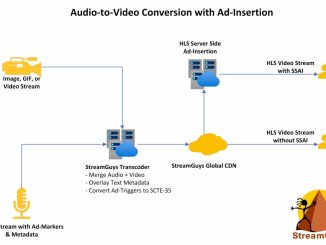
At the 2023 NAB Show, Streaming and podcast solutions provider StreamGuys will unveil new video and audio conversions demos that prove how radio broadcasters can expand business models to visual radio and other video-centric workflows – and offer OTT service provides, video content creators, and other customers ways to replicate and monetize audio streams from their existing video streams.“This is all about demonstrating the power of live stream and ad insertion marker conversions in both directions,” said Eduardo Martinez, Vice President of Technology for StreamGuys. “We continue to extend the reach of our SaaS suite, and our latest workflow conversion tools will automatically turn SCTE-35 video ad insertion markers to ID3 metadata markers used in some audio-only insertion tools. That offers video producers and broadcasters a very cost-effective way to deliver audio streams with dynamic ad insertions. From the opposite view, we can use our same workflow management technology to unleash traditional radio streams to serve more video-centric workflows, and help radio broadcasters expand their audiences.”StreamGuys’ new video and audio conversion capabilities evolve from its SGrecast podcast management platform, which features tools to repurpose live streams as podcasts or rebroadcasts. Like SGrecast, StreamGuys’ SaaS toolset will automatically convert and republish live content, and expand their distribution and monetization footprint to reach new audiences.

However, while SGrecast is very much focused on helping the radio broadcaster repurpose live content for other audio segments or streams, StreamGuys’ new conversion tools are truly media-agnostic. This creates an entry point into OTT and FAST (free ad supported television) channel services for radio broadcasters, for example. “We want the radio broadcaster to look beyond getting their stream onto audio aggregation platforms, and start producing their traditional feeds with video platforms in mind,” said Martinez.Martinez notes that StreamGuys is already working with a major over-the-air broadcast network in the United States to bring their TV content into the audio streaming landscape. “With our new SCTE-35 tools, we can now automatically identify SCTE-35 markers and turn those traditional TV broadcasts into audio feeds without having to run a separate encoder. They maintain all the efficiencies of the mid-roll markers they have already produced for TV ad insertions on the audio-only outputs. All the customer needs to do is provide us with a single public or third-party source stream, which we will then convert and output in the desired video and audio formats and maintain through our 24/7 support services.”StreamGuys will once again have a presence on the ENCO booth (W1743, April 16-19, Las Vegas Convention Center), where the company will talk about their new conversion toolsets can integrate with visual radio, automation, captioning and other video/audio systems from ENCO and RUSHWORKS. StreamGuys will also provide demonstrations into other recent innovations, including its recently expanded SGcontrol Content Access Suite for access control, licensing and monetization. Introduced at NAB last year, StreamGuys announced a new API for SGcontrol in January that automates programming and functionality, accelerating the deployment of new streams, features and services. […]
ASIA

Organisations that do business with us want accountablity #AbuRaiDays

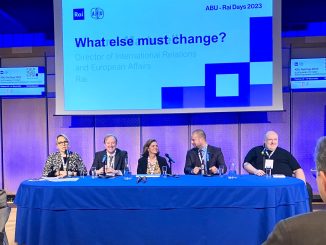
What else must change, was the question asked in the opening panel session on Day 2 of ABU-Rai Days.Issues covered in the discussion included due diligence, changes in governance, operational risks, cultural alignment, as well as global and local competition.Rai Sustainability ESG Deputy Director, Micol Rigo said sustainability “is a great opportunity to re-establish our role in society, in the areas of environmental, social and governance.”

“Organisations that do business with us have been urging us to be accountable for our sustainability.” The first pressures came in through finance compliance reporting requirements and now there more pressure for wider corporate sustainability reporting “It is a challenge, but we need to drive the change and manage the uncertainty that will come with it. “A company’s responsibility is to make a profit, but what is the idea of profit? Is it just money or does it also include long term decision making for the good of the planet? This is an opportunity for us to become leaders in the area of sustainability,” said Rigo.EBU Director of Legal and Policy/General Counsel, Richard Burnley quoted Leonardo Da Vinci: “People of accomplishment don’t sit back and let things happen to them. They go out and made things happen.”“We are trying to shape the regulations proactively within our PSM ethical framework, not letting things happen to us.“Software companies are putting binding clauses in their customer contracts to ensure sustainability… companies are including clauses that ensure cooperation for sustainability without compromising competition laws.Media companies first got on board with sustainability to improve their reputation, but now they are moving from a reputation based to a legal based motivation, where they will be able to show their legal and regulatory compliance.“We need to monitor our progress to avoid Green Washing – making false claims or claims that you can’t substantiate.”Quoting various academic studies, Università Svizzera Italiana Professor Matthew Hibberd urged broadcasters “to be more positive about what can be done about climate change in our coverage, show what people can do.”He also made the point that the sustainability of broadcast companies needs to be addressed too, because broadcasters are losing out to the global world of big tech and to misinformation. “Public service broadcasters have tried to keep up, but in reality have lost ground to big commercial tech companies… PSBs are also now under pressure from disinformation channels.” European News Alliance, Secretary General, Alexandru Giboi applied the sustainability lens to News. “We must secure the present without ruining the future,” he said.“Our public is slowly fading away, so to ensure that we still have an audience in future, media need to adapt and find the right channels to attract the younger audiences. “News agencies have already started to do so. We are adapting our newsgathering and our output so that audiences will remain interested in the news output we have to offer, but we are not losing the responsibility we have to report the news correctly.”He pointed to a new trend where young audiences are searching directly for news on TikTok and Youtube, rather than through general search engines. Audiences now want content that they are interested in to find them, they don’t want to have to go searching for it.“The old way was to go to a press conference and quote the person who spoke about the topic. Audiences no longer want to consume that type of news. The sustainable approach to news should address the whole value chain from when the story is gathered to when it reaches the audience. If we don’t connect our news to audiences, we will lose our relevance.”Journalist training and media literacy are two other areas where more work needs to be done so ensure news sustainability. “Media literacy is important so that people understand the important role that good media can play in society.”One of the legal issues facing broadcasters is the misappropriation of their signals, for example the illegal rebroadcasting of sport, according to ABU IP and Legal Committee Chair, Suranga Jayalath.Sustainability was a theme running through all these topics, from environmental sustainability to the sustainability of media business models in the modern competitive environment. […]

ASIA

Showcasing a sustainable media industry #AbuRaiDays

The second session in today’s ABU-Rai Days conference was titled Showcasing a sustainable media industry and explored how some major broadcasters in Europe and Asia Pacific have taken up challenges of making their organisations and activities more sustainable.The session was moderated by RAI International Relations and European Affairs Director, Simona Martorelli (pictured).The first speaker, MediaCorp Singapore Head, Sustainability & Lead, Production Services, James Hollis, began in his role less than a year ago without a background in sustainability. He outlined how he brought a bottom-up approach to implementing a more sustainable company culture by involving 70 volunteer employees to help drive the change. This was made through what the broadcaster describes as a AAA framework:

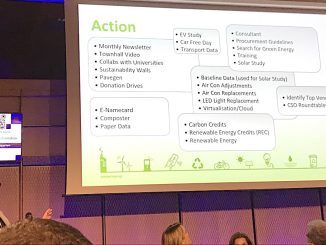
ACTION: James gave examples of new ways they are implementing more sustainable solutions such as solar energy to offset 6.5% of the energy consumed. Solar trees have been installed on the roof as a shared space that staff use (pictured below); virtualisation of operational servers reduces space and has less energy usage; green walls in the building make sustainability visible to staff, who can harvest the vegetables grown on the walls each week. Other initiatives include: monthly news letters, clothing drives for charity and quizzes to increase staff knowledge.

AWARENESS: included having an understanding of business, regulatory, audience, employee expectations; The Awareness approach was driven from the bottom up. The broadcaster also has a sustainability council made up of heads of department so that the Content division has a commitment on sustainability.
AMBITION: Carbon neutral targets; expert consultants used to help broadcasters achieve their aims, because sustainability his not a broadcaster’s core business.
RAI per la Sustainability ESG Director Roberto Natale, and Deputy Director, Micol Rigo explained the importance of having a top down approach to focus on the areas of Environment, Social and Governance.The goal is for sustainability to become structural within RAI as part of redefining the role of Public Service Media. The formula to achieve this goal is content + dedicated governance +Ad-hoc Plan. An example of ESG in content is the television drama, A Place in the Sun, where one of the characters reminds the other to keep the heating temperature at home on 19 degrees.RAI’s focus on sustainability led to organisational change. The ESG activities and milestones are being tracked carefully within the organisation as change takes place.Accountability is evident in the plan below where the majority of the goals are achieved or in progress.The learning from the experience is divided into checks and balances or strengths and challenges.
Areas: Environment, Social (Campaigns), Governance
Goals: Sustainability to become structural for RAI as PSM and to redefine the role of PSM
How: content +Dedicated governance +AD hoc Plan
Need to reach wider audience and enter the programs where viewers don’t expect to find sustainability content e.g. A place in the sun e.g. dialogue
Vision and strategy: importance of setting goals and to measure our achievements; Nine social value are already at the core of our mission “a chance to build from where you are to make a cultural change by building our priorities, taking account of governance and what is financially possible. Importance of setting targets eg. How many more people do you wish to engage?
Goals were prioritised and accountability achieved my measuring the outcomes.
ABC Radio Sydney Manager, Steve Ahern is Chairman of the Green Ears project in Australia, which focuses on sustainability in the radio and audio industries. He outlined the commitment of all Australian audio broadcasters to support increased sustainable practices through this initiative.
Radio and Audio are the most sustainable of the media industries compared with the tv/screen, outdoor advertising and film industries.
The Green Ears project unites all sectors of audio broadcasting in Australia with the goal of improving sustainability, because audiences and advertisers are demanding accountability from their broadcasters.
Transmissions is generally the largest contributor to emissions (Broadcast and Streaming) however Digital (DAB+) transmission significantly reduces power usage with its multiple shared services on one transmitter. The next largest contributors to emissions for broadcasters are usually communications (telcos, cloud computing) and buildings.
The EBU’s Sustainability Lead, Hemini Mehta focused on sustainability for Public Service Media, highlighting Organisational strategy, Carbon calculators, reporting, Buildings/ transport/ travel
Green production initiatives use Carbon Calculators to identify Waste/ Travel/ and Energy usage.
Responsible use of the Cloud is needed and there must be transparency using metrics so that cloud carbon emissions are captured right through the chain to give a real indication of whether cloud storage and distribution is really sustainable or is just transferring costs and responsibility to someone else down the chain.
Sports and sustainability: working with sport federations and broadcasters and exploring how to make sports events in a greener way, as well as how to bring the audience on the journey.
News about climate change, including how to inform the viewers but also to resonate with them. […]

ASIA

A sustainable next generation media ecosystem #AbuRaiDays

As this year’s ABU-Rai Days conference began in Florence Italy, Rai President Marinella Soldi welcomed delegates from Europe, Asia and Africa saying:“ABU Rai Days fosters dialogue between different cultures and regions. Even though we may seem different one thing unites us all, the topic of this conference – sustainability. The sustainability of our media organisations and the sustainability of the planet.“At RAI we are trying to build our sustainability strategy around environmental, social and governance,” she said.

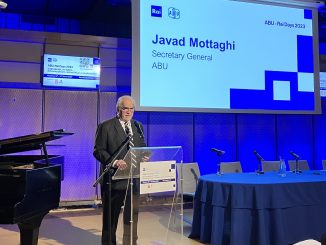
ABU Secretary General Javad Mottaghi, in his last conference before retirement, thanked RAI for organising the east west dialog, “where we can take advantage of the opportunities to talk together to find solution to the common challenges that broadcasters are facing today.”“There is a growing economic and digital divide… There are natural and man made disasters facing us. Public service media must serve the public and help societies solve these challenges…“In this magnificent city humanity changed, the renaissance was born here and humanity found a new way of understanding medicine, science and arts. The renaissance also questioned dogma and brought the rebirth of new ideas. Media plays that role today, this is part of what we are doing here at this conference.”  The Mayor of the City of Florence, Dario Nardella told delegates how proud he was that his city was chosen for this conference:“It is important for our broadcasters to concern themselves with climate because this is about our future. Raising awareness in every citizen is crucial… Cities produce 80% of CO2, they are part of the problem but can also be part of the solution if they commit to achieve carbon neutrality… Everyone must do their part, we can all make a difference,” he said.Florence is part of a movement called Eurocities where cities are all working together to develop projects aiming for climate neutrality through a range of projects and experiments in cities across Italy. He asked the broadcasters to work together with public organisations such as Eurocities “to create a more sustainable world.”After the opening session, a Superpanel hosted by Marinelli Soldi canvassed the topic: A Sustainable Next Generation Ecosystem“At Rai we divided the world into on screen and off screen. Off screen is governance and how we manage the business. On Screen is what we produce. We then approach our work through these lenses it helps us be clear about what we do.. we look through these lenses for sustainability too,” said Soldi.Javad Mottaghi urged public service media to continue winning the trust of the public, “because without trust we will not exist in the face of the many challenges facing us in this changed world. He outlined some of the challenges faced by public service broadcasters. “The first challenge we face is that we may lose audiences to commercial stake holders, other broadcasters plus the internet. The second challenge is understanding the audience and what they want in the new environment. The other challenges are financial, technological and the way we interact with governments.”EBU Director General, Noel Curran spoke about the EBU’s specific role and responsibilities. “We have news and current affairs responsibilities, but sometimes we report too much and explain too little. Explaining requires an investment in expertise, plus creativity and education, not just covering the day to day and week to week news events…“Public service media is known as the most trusted medium when reporting issues of climate change. Not everyone is interested in this topic according to an EBU survey which showed 25% of people saying they have no interest in climate change and many others having no engagement on this topic.“It is our job to engage audiences by using our creativity and programming to explain to them what the issues are.” He gave the example of the tv series The Blue Planet where 80% of viewers say the program inspired them to change their behaviour. “If we seek to educate and are creative and include these issues in our drama and other areas of programming, then we can overcome the challenges of people not being interested or just thinking that it is someone else’s problem,” he said. […]

ASIA

Australia’s ABC and Timor-Leste’s RTTL sign MOU

The Australian Broadcasting Corporation (ABC) has signed an historic agreement with Radio e Televisoa de Timor-Leste (RTTL).The agreement between the two public broadcasters allows for increased content sharing and media development programs.It recognises both organisations’ importance as cultural institutions and custodians of media archives, as well as the vital role they play in connecting and informing audiences and contributing to democracy.

The Memorandum of Understanding builds upon an existing strong relationship between the ABC and RTTL.
ABC Radio Australia has been available to Timorese audiences via FM radio for many years. More recently, ABC International Services entered a content sharing agreement for the distribution of ABC Australia and ABC Education content on RTTL digital platforms. This agreement was announced as part of RTTL’s 20th anniversary celebrations in 2022.
ABC International Development has supported media development in Timor-Leste over the last decade, working with Timorese media to develop inclusive and diverse reporting processes, advising on reporting of natural disaster preparation, maintaining technical broadcasting equipment and conducting media training on accurate COVID-19 reporting and combatting misinformation.
Under the Indo-Pacific Broadcasting Strategy, ABC International Services will work with RTTL to help it establish a news service for its new English-speaking channel, sharing content from the ABC newsrooms and working with RTTL staff to enhance their journalism and content making skills.
Other activities include establishing a network of Pacific journalists, with a local correspondent based in Dili, the syndication of ABC content to local media providers and a broader capacity-building program for Timor-Leste media and journalists’ associations to build media craft skills.
In late 2022, a senior ABC International delegation visited Timor-Leste to acknowledge and strengthen the relationship between the public broadcasters in the lead-up to the signing of the MOU.
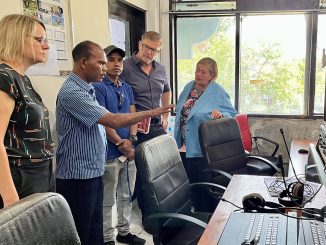
RTTL President José Antonio Belo says, “This is an important moment for RTTL and ABC to cement the historic relationship and express our shared values. “RTTL is happy to build on the spirit of friendship and collaboration and, in particular, to learn from ABC as we establish our English news service and channel.”ABC Managing Director David Anderson says, “The ABC is committed to working with RTTL, and the people of Timor-Leste, and to learning from each other as both organisations seek to better serve our audiences.”Main picture: RTTL Technician Ximenes Babo showing ABC International Development representatives the control room. […]

ASIA

Economics, Environment, Emergency – driving the case for DAB+ at ABU DBS

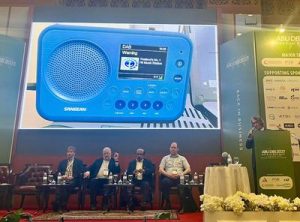
On the first day of the Asia-Pacific Broadcasting Union (ABU) Digital Broadcasting Symposium, over 150 delegates attended the WorldDAB workshop: “Economics, Environment, Emergency – driving the case for DAB+.”WorldDAB Project Director Bernie O’Neill updated the audience on the platform’s global growth, noting that DAB+ was now well established and growing in Australia, with Asia Pacific markets continuing to run trials, and a step change in interest from Africa and the Middle East. Along with continued development and innovation in more established DAB+ markets, “deployment of DAB+ in Asia Pacific, Africa and the Middle East is a priority,” O’Neill told delegates.DAB’s Service Programme Information feature was growing in importance, said Lindsay Cornell, Chair of WorldDAB’s Technical Committee, who announced the creation of a Task Force to update the specification to make aspects easier to interpret, and to include new XML features relevant to broadcast.

Cornell also noted that the receiver testing ETSI standard had been updated with extra requirements to make it suited to a much wider geographical area. It will now incorporate tests that ensure delivery of non-Latin text to suitable displays, including EBU Latin, All Europe, ASBU, Thai, and Greek and Cyrillic characters.Chair of WorldDAB’s APAC Technical Group, Les Sabel, updated the audience on DAB+ developments in the region. He noted trials in Thailand, including functional testing, outdoor and indoor field testing, supported by education and training. In Bangkok, the trial broadcast 18 audio and one data service, with a 10 kW ERP central Bangkok transmission site. Other trials were focussed on four regional areas and centres: Chon Buri, Chiang Mai, Khon Kaen and Song Khla.Sabel also spoke about the development of small-scale DAB, which he described as “essential” in helping community radio stations to participate in digital radio’s future. This often uses open-source software and SDR solutions for support systems, and it was “being increasingly valued and added to countries’ regulation frameworks,” Sabel said.Continuing the small-scale DAB theme, “think differently, work locally,” was the advice from Nick Piggott of Bristol Digital Radio, a multiplex operator in the west of England. “We’ve built a minimum viable product – a saloon car, not a luxury vehicle,” he said. “DAB can be done very cost-effectively without disrupting the existing ecosystem to make the most of the opportunity.”Lars-Peder Lundgren, CEO of Paneda Sweden, spoke about emergency warnings on DAB, noting the robustness of broadcast networks. “There have been many cases where mobile networks and internet were down, but never DAB,” he said. “In some situations, mobile networks are shut down on purpose. Broadcast networks are most reliable, with 99.9% uptime as a minimum.”Innovations in transmitters were the focus of a session from Oscar Hu, Regional Sales Manager, Southeast Asia, GatesAir. Last year, the company launched the first self-contained, fully weatherproof transmitter series, built for challenging coverage areas and unusual install points.Finally, the ease of a modern DAB roll-out was highlighted by Hermann Zensen, Head of Sales and Marketing, Digidia. Modern DAB head ends are completely software and IP based and therefore compact, easy to install and maintain, even remotely. This means it is possible to start cost-efficient trial systems very quickly, Zensen said. […]